The Celtic traditions have long held deep meaning for me. There's something about the Incarnational and holistic approach that makes it theologically and practically impactful and relevant in my mind. I have been a reader of Christine Valters Paintner's devotionals and work for a few years now, and love her spirit and wisdom.
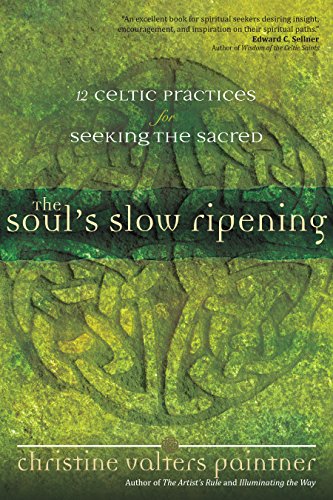
All of this made me interested in her newly released book, The Soul's Slow Ripening: 12 Celtic Practices for Seeking the Sacred. What is unique about Paintner's approach is that she provides a personal spiritual story, some historical background, biblical reflections, and concrete spiritual formation-type activities, including lectio divina and even photography, to help bring these practices home.
I also appreciate that her husband, John, regularly contributes to the reflections and applications of the practices. Another voice and perspective, albeit aligned nicely, bring additional context and wisdom to the text.
Paintner explicitly states that this book can be read from front to back, but also can be digested in any order desired. It really is that flexible, allowing the reader to dive into whatever practice is most relevant at a given moment. The subheadings and different aspects presented to each practice not only make them more concrete and readily applicable, but also provide easy moments to pause in readings and pick back up.
This isn't necessarily a book that one would read once through for lessons, although it could be used that way. Rather, it could be more of a reference tool, being picked up at different phases of life for wisdom and spiritual suggestions. There's enough variety and diversity that I can see it being useful in many contexts and phases of life.
It has enough philosophy and theology that it can have meaningful depth for those desiring traditional substance. It also has excellent practicality that it doesn't feel too "spiritual," abstract, or philosophical. The Paintners both come across as very practical to me, striking an excellent balance between Heaven and Earth.
If you're interested in Celtic traditions, this is an excellent addition, either for early explorers or even those seasoned in Celtic Christianity and spiritual formation.
Disclosure of Material Connection: I received this book free from the publisher. I was not required to write a positive review. The opinions I have expressed are my own. I am disclosing this in accordance with the Federal Trade Commission’s 16 CFR, Part 255: “Guides Concerning the Use of Endorsements and Testimonials in Advertising.”
This page contains affiliate links. If you make a purchase through this link, we may receive a portion of the sale at no additional cost to you.
Showing posts with label Bible. Show all posts
Saturday, December 15, 2018
Monday, July 31, 2017
Review: Developing the Bible and Faith Through Story
This review first appeared on the Englewood Review of Books.
Disclosure of Material Connection: I received this book free from the publisher. I was not required to write a positive review. The opinions I have expressed are my own. I am disclosing this in accordance with the Federal Trade Commission’s 16 CFR, Part 255: “Guides Concerning the Use of Endorsements and Testimonials in Advertising.”
Books on the Bible are a dime a dozen, with some worth even less than that. Much ink has been spilled on the nature of the Bible and interpretations of various passages. Often, these books are either overly academic, unrelatable to many readers, or intellectually unsupported.
Rob Bell's latest text, What is the Bible?, is none of these things. In his book, Bell tackles a variety of Scripture passages in order to better help us understand the fundamental nature of the modern Christian Bible. In short, Bell actually answers his book's titular question with its subtitle: How an Ancient Library of Poems, Letters, and Stories Can Transform the Way You Think and Feel About Everything. The Bible is intended to transform our thoughts, beliefs, feelings, and actions through a variety of narrative methods in order to better respond to the world we live in.
In typical Bell style, What is the Bible? is broken up into highly readable and digestable chapters clustered into multiple parts that form an overarching narrative. Initially, the first few chapters were interesting and thought provoking regarding the specific passages being interpreted. However, they seemed disconnected from a larger coherent thesis. It takes most of Part 1 for Bell to really start making his core argument.
At first this approach was annoying and off-putting. The book seemed more helpful as an encyclopedia-type resource that could be helpful in interpreting particular Scriptures. This is not a bad thing in itself, but not exactly how the book seems to be advertised. However, as the pieces came more clearly together, the final effect was far more powerful than a traditional exposition on the nature of the Bible. Interestingly, this approach somewhat mirrors the way Scripture powerfully shares the transformative power of Yahweh and the Gospel--individual stories that don't always seem to connect, but still tell a deeper, developing tale.
Growth and development is really core to Bell's understanding of the Bible. Central to his interpretations of passages are the iterative steps needed to help humans move to new levels of understanding themselves, their neighbors, and the world. This hermeneutic provides compassion for people and situations that are otherwise easy to judge. Building compassion is one of the core traits that God is trying to build in people, so having compassion for our spiritual ancestors is a good place to start. However, a developmental approach to the Bible seems to consistently not be easy for humanity. We tend to take more of a stagnant approach to understanding all things spiritual, trying to make the case for a single perspective and set of laws that are good for all people of all ages in all places in all times. We don't do this with any other part of human development, recognizing the many variables that impact our development (or lack thereof). And when we recognize development has been limited, we can often acknowledge the contextual factors, giving us a chance to better understand where someone is coming from and have compassion on them.
Development, growth, and change, both as individuals and a species, are normal for all parts of humanity. Remembering that this applies to our spiritual lives can be transformative in how we see ourselves, others, and the Bible. Bell actually ends the entire book (even after the traditional Endnotes) with a section entitled A Note on Growing and Changing. He emphasizes this central role of growth and change, providing encouragement to those who may have experienced development, but whose communities may be uncomfortable with the change. Part of this encouragement also builds compassion for ourselves and what was helpful before, recognizing that what was useful at one point in our lives may not be now. This approach might help us better integrate our many lifetime spiritual influences.
This developmental view is similar to Peter Enns' perspective presented in The Bible Tells Me So. Both men use helpful subtitles to clarify their purposes. Enns' is Why Defending Scripture Has Made Us Unable to Read It. Enns is really more focused on helping us be more open to reading the Bible as it is. He includes a bit more scholarship related to biblical interpretation, as this is the core of his text (plus it's more of his background). Bell, on the other hand, is a storyteller at his core, and his theme is more helping us better understand ourselves and our world. Both authors use some similar language to talk about the Bible, and they have similar, accessible, digestable writing styles. These two books could be good as complementary texts, and do not necessarily duplicate efforts.
As noted, Bell is a storyteller. He is famous for his engaging, thoughtful, and moving oration and writing, and this book is no different. His style and approach is consistent with his past work, so readers who like his style will not be disappointed. He effectively brings biblical passages to life in a way few others can. It also works very well in this book, as his writing approach creates an accessibility and relationality that reduces defensiveness, creates intrigue, and invites questions. This is exactly what Bell wants in this book: He wants readers of the Bible to ask questions. Lots of questions. And some of his final chapters are focused on helping people ask good questions.
Bell's book is titled with a question, but he doesn't directly answer the question. In fact, it's a question that is likely unanswerable in a concise, direct approach. A book entitled What is the Bible? seems to be one that would have a lot of direct exposition to provide great clarity on such important topics as the nature of the Bible. However, true to Bell's style (and frankly the way the Bible and Jesus taught), the answers are provided through story, specifically helping us better understand individual stories in the Bible and how they connect as part of a larger story. There is a section where Bell more directly answers questions. In fact, it's about a quarter of the book. But this section is the end. Even the more direct analysis and argument is explained through story. In many traditional contexts, the exposition comes first, with stories used as illustrations and clarifications. However, a traditional approach would not have been as effective, as it likely would have put readers more in their heads, preparing intellectual arguments for or against. Bell's story first style creates a situation that is far more powerful than traditional argumentation. He is not merely making a scholarly, academic, intellectual claim. By putting answers to questions at the end, Bell is bringing readers along into a spiritual life that must be experienced to be understood.
What is the Bible? is a strong entry in both Bell's library as well as the general discussion of biblical understanding. He has a well-educated, but accessible style that makes challenging concepts more easily digestable. However, this text is no pop spirituality or pop theology text. It provides appropriately informed reflections that lead to solid new insights that can contribute to our on-going spiritual development through the value of biblical and modern story.
Disclosure of Material Connection: I received this book free from the publisher. I was not required to write a positive review. The opinions I have expressed are my own. I am disclosing this in accordance with the Federal Trade Commission’s 16 CFR, Part 255: “Guides Concerning the Use of Endorsements and Testimonials in Advertising.”
Monday, June 8, 2015
Review: Desiring Atonement
Atonement can sound like a boring, droll topic (and it is to many people). However, it's also central to Christian theology and the topic of many vicious debates (some people's ordinations and even salvation statuses have been questioned due to even minor differences in atonement beliefs). For those not familiar, atonement in Christianity refers to becoming reconciled with God. I have previously written on atonement, including problems with "traditional" atonement theories, the application of René Girard's mimetic theory to Christian atonement, and the fundamental question of whether God needs to be appeased.
A few authors have written on similar topics, but André Rabe's recent book, Desire Found Me, provides a very thorough exploration of how mimesis impacts not only atonement, but a variety of fundamental Christian theological points. His is an incredibly ambitious project, not just describing a mimetic atonement, but laying a foundation of how mimesis provides a better explanation of Scripture all the way back to Genesis 1.
Some might think this foundation is too much. To be fair, it can be a lot to digest, although he makes fine theological points accessible (with appropriate background) to those unfamiliar with the topics, while also not being overly simplistic for those with more knowledge of some topics (his writing structure makes it is easy to skim where appropriate). However, discussing things such as human nature, justice, and even Satan are critical to understanding and constructing a theory of atonement. Even while being familiar with and having written on many of these topics, Rabe provides helpful strong evidence and detailed explanation supporting more accurate Christ-centered interpretation of Scripture than other more human-centric hermeneutics. He provides a nice balance of his own writing with strong citations showing a solid scholarly approach to Scripture, hermeneutics, and Christian history.
For those interested in mimetic atonement, restorative justice, and love-centered reading of Scripture that is more cohesive than the limited narratives told by so many others, I highly recommend Rabe's text.
Disclosure of Material Connection: I received this book free from the publisher. I was not required to write a positive review. The opinions I have expressed are my own. I am disclosing this in accordance with the Federal Trade Commission’s 16 CFR, Part 255: “Guides Concerning the Use of Endorsements and Testimonials in Advertising.”

A few authors have written on similar topics, but André Rabe's recent book, Desire Found Me, provides a very thorough exploration of how mimesis impacts not only atonement, but a variety of fundamental Christian theological points. His is an incredibly ambitious project, not just describing a mimetic atonement, but laying a foundation of how mimesis provides a better explanation of Scripture all the way back to Genesis 1.
Some might think this foundation is too much. To be fair, it can be a lot to digest, although he makes fine theological points accessible (with appropriate background) to those unfamiliar with the topics, while also not being overly simplistic for those with more knowledge of some topics (his writing structure makes it is easy to skim where appropriate). However, discussing things such as human nature, justice, and even Satan are critical to understanding and constructing a theory of atonement. Even while being familiar with and having written on many of these topics, Rabe provides helpful strong evidence and detailed explanation supporting more accurate Christ-centered interpretation of Scripture than other more human-centric hermeneutics. He provides a nice balance of his own writing with strong citations showing a solid scholarly approach to Scripture, hermeneutics, and Christian history.
For those interested in mimetic atonement, restorative justice, and love-centered reading of Scripture that is more cohesive than the limited narratives told by so many others, I highly recommend Rabe's text.
Disclosure of Material Connection: I received this book free from the publisher. I was not required to write a positive review. The opinions I have expressed are my own. I am disclosing this in accordance with the Federal Trade Commission’s 16 CFR, Part 255: “Guides Concerning the Use of Endorsements and Testimonials in Advertising.”
Monday, January 12, 2015
Does God Need To Be Appeased?
As atonement continues to come up in our Sunday school class, I continue to reflect on how much a substitutionary view has been central to our theological language. Propitiation is a perfect example of this. Propitiation is a common term used in atonement discussions and other areas of theology. It's a fancy word for appeasing someone, often the Divine.
There's just an assumption that someone has to be appeased. But is that necessarily so?
Humans need to be appeased; there's little doubt about that. But the Divine? When made in humanity's image, the Divine surely have to be appeased. However, from a Christian perspective, we are made in God's image, yet we are different. I'm increasingly convinced that the transactional, conditional acceptance notions we have in our theology are not from God, but from our broken human nature.
Others have talked about some of the problems with the various atonement theories, namely substitutionary and ransomed theories. The idea of propitiation is really central to these criticisms, as who does God have to appease and what kind of character does a God have who needs to be appeased?
The mimetic theory of atonement seems to address some of this. It doesn't minimize any of the biblical record, but in my view, recognizes the human theological evolution and understanding that develops over centuries/millennia.
Does someone need to be appeased for our salvation? Yes, but nothing divine. I'm inclined to believe it's us who need to be appeased for our own wrongdoings. We are the ones who can't get over ourselves. So God provides a way for us to move past it and to him.
How does this change our view of salvation? Of God and his character? Of the Bible?
Monday, September 29, 2014
Fighting Biblical Literalism with Literalism?
I'm not a fan of literalistic readings of the Bible in general. There's just no argument from any worldview, in my opinion, that supports this exegetical method. Even if every word was spoken by God and transcribed by humanity, that doesn't mean every word is literally true, as no one (even Jesus) spoke that literally all the time. And even Jesus' words were obviously highly contextualized, so "plain meaning" in our time just doesn't make any sense.
When taken too far, there are some extra special absurdities derived from literal interpretations of biblical text. Therefore, some people like to argue against a universally literal reading of the Bible by pointing out inconsistencies generated by such a reading. I can find this humorous (and appropriate) at times, as it helps keep all of us honest. As an example, one could argue against requiring a belief in a 7 day creation period by showing what else we would have to believe by the same interpretive methodology. The point of the argument is not to promote a particular interpretation necessarily, but to argue against a particular interpretive methodology.
However, then there's other times when I see people fighting conclusions made by literal interpretations by making another literal interpretation after criticizing this exegetical method. This is different than what I described above, as the methodology is undermined, but then the same methodology is used to come to a different conclusion.
Let me give an example. In our Sunday school class, we're exploring Borg and Crossan's The First Paul, discussing authorship and interpretation of the Pauline letters. For those who don't know, Borg and Crossan are squarely liberal scholars. They do not ascribe to literal readings of the Bible. In fact, a central component of their thesis is that only some of the letters attributed to Paul were authentically written by Paul. The rest, Borg and Crossan argue, were attributed to him in a way that often happened at the time. This argument alone helps undermine a literal reading of Paul.
However, part of the way they argue for different authorship is through a literal reading of the texts. They have several examples, but one is the topic slavery, as they see Philemon advocating for abolition (perhaps only of Christian slaves), while reading Colossians 3:22-4:1 and Ephesians 6:5-9 as advocating for the maintenance of slavery. However, the latter verses never explicitly support slavery. They could definitely be read that way (and have been in the past, of course). However, I see both of these as very superficial, literalistic, non-contextual interpretations.
Borg and Crossan's conclusions may be absolutely correct, but methodology matters. At least in this context, I do not find they have a rigorous explanation for their exegesis, as they are relying on a plain meaning of the text, which they clearly do not support themselves.
I find it interesting that some liberal scholars seem to do this. They clearly reject biblical literalism (and have changed their belief structure often in reaction to it, sometimes to the point of rejecting Christianity, like Bart Ehrman), but then use literal interpretations to make their arguments. I wonder if they seem to believe that the Christian community only values literal interpretations and in order to be heard, they have to use that methodology. Obviously, that's not true.
Historically and currently, a significant portion (perhaps even the majority, although they tend to be quieter) of Christians appreciate and value good non-literal exegesis. In fact, demonstrating that faithful Christians can interpret the Bible non-literally and still value it is critical to maintaining the faith of many and even evangelizing to many. So personally, I find it detrimental to the community of faith when those who have rejected literalism primarily use a literal interpretation to get to their points. Biblical literalism has already been effectively discredited for decades, if not longer. Rather than continuing to use it to make our arguments, lets show how good, faithful scholarship can actually be done.
Monday, May 19, 2014
Is Biblical Archaeology Helpful to Faith?
When I was living with my grandpa, one of our monthly traditions was to go to a local meeting of the Biblical Archaeology Society. I long have had interest in archaeological findings, as I think it provides a richness and context to a variety of historical narratives. So getting the opportunity to review Discovering the City of Sodom: The Fascinating, True Account of the Discovery of the Old Testament's Most Infamous City was exciting.
Drs. Steven Collins and Latayne C. Scott explore the story of how Collins sought a new location for Sodom and his argument for Tall el-Hammam as the site of biblical Sodom. I found myself regularly tuning out of the first part of the book, detailing some of the historical arguments. While I've listened to many of narrator Sean Runnette's audiobooks, there was a lack of passion to hold interest in more nuanced intellectual arguments (and people who know me know I love those discussions :) ). It felt more like he was truly just reading a paper he knew nothing about. Unfortunately, I'm discovering a lot of Christian nonfiction narration is like that...
The explanations as to why Tall el-Hammam made sense as biblical Sodom was where more of my interest re-arose. Hearing about the historical context and how archaeology can help us better interpret the Bible is helpful.
I also really appreciated how Collins ended his book addressing the various critiques of his work. Some arguments center around whether a biblical Sodom ever truly existed while others debate biblical interpretation. Collins' biblical interpretation centers around a theory of true narrative representation. While I won't claim to fully understand this approach, I think it makes a few too many assumptions demanding the historicity of the biblical texts. I see it being driven more from a perspective of people's faith needing the Bible to be historically true than honestly approaching the texts and how they were meant to be read.
This doesn't mean they are not historically true. I don't see any need for the story of Sodom to be historically true. However, I think those who deny archaeological data supporting biblical Sodom's historicity due to their interpretations of the Bible aren't being fair or honest, either. While I am most definitely not even a novice or amateur at reviewing archaeological material, Collins' arguments make sense to me. His willingness to engage in debate and address disagreement lends credibility. He does seem to want to be academically honest with himself and others.
However, at the end of the day, does it matter whether Tall el-Hammam is biblical Sodom or not? Whether biblical Sodom was historically real or not? The latter may impact some people's respect of Genesis, but I think there's problems with that approach. I'm not sure identifying the physical location and archaeological remains of biblical Sodom really adds much to our understanding of the biblical world or narrative. Other archaeological sites can provide clarity, especially to more important narratives (yes, I'm saying the Sodom narrative is not one of the most critical). Some stories really can be elucidated more by archaeological evidence. But I'm not sure what the value added is to the Sodom narrative beyond it being it being interesting...
Disclosure of Material Connection: I received this book free from the publisher. I was not required to write a positive review. The opinions I have expressed are my own. I am disclosing this in accordance with the Federal Trade Commission’s 16 CFR, Part 255: “Guides Concerning the Use of Endorsements and Testimonials in Advertising.”
Monday, March 10, 2014
Expositional Preaching on Ruth
My faith has increasingly focused on the centrality of love in the Gospel. My professional perspective is oriented toward love in relationships (not always framed in those terms, but with that concept). So Paul Miller's book, A Loving Life In a World of Broken Relationships, sounded intriguing. It was better than a pop-theology/pop-psychology book in that Miller grounds most of his assertions in the Bible. But in reality, it was essentially a series of expositional preaching lessons on the Book of Ruth.
While the topic of expositional preaching can be controversial in itself (some say it's the only way to preach, others think it's horrid and unhelpful), I think it can be useful, but if done right. While I found it interesting doing a sort of in-depth study on Ruth, the re-connection Miller attempted to make to the contemporary world was not terribly smooth. Some of the major problems were with his misrepresentations of psychological processes and groups of people with whom he disagrees.
For instance, a central punching bag in the book is what Miller terms a "feeling culture." This refers to putting feelings as primary and paying attention to them as an element of authenticity. Miller claims some parts of prioritizing feelings that are just simply not true. He asserts that people from this perspective believe that in order to be authentic, you have to do what you feel. Not true. As a psychologist, I definitely put a priority on both feelings and authenticity, but feelings are only one part of who we are. Ignoring them is as inauthentic as letting them bulldoze over our rationality and other priorities. He also claims that the Christian value is to just not let our feelings affect us. This is a major myth in conservative Christianity, and it's just not possible. The reality is that emotions (what he really means by feelings) are always occurring within us and always affecting us. That's part of being human. But that does not necessarily mean that we choose to behave based on what our emotions are moving us toward.
He also makes big claims about other groups/movements/perspectives, like mysticism and meditation. Having studied both academically, I can say that Miller clearly does not understand these concepts, instead going for oversimplistic stereotypes created by people who have had little to no exposure to what these ideas are really about. Unfortunately, Miller uses these various constructs to differentiate his claim of what love is. If he truly understood these other cultures, he would know that they are not necessarily as different from his approach as he thinks they are. They're definitely not as threatening.
Arthur Morey narrated the audiobook, and I've listened to many of his books. He has a great voice, but this book just fell flat. It sounded almost monotone. I'm not sure it was Morey's fault, but perhaps the unengaging content that felt like a dry sermon. I had trouble listening to the whole book and regularly found myself having to rewind because I tuned out. It's really unfortunate because there was potential for a lot of good in Miller's text. It just needs a major revision for accuracy.
Disclosure of Material Connection: I received this book free from the publisher. I was not required to write a positive review. The opinions I have expressed are my own. I am disclosing this in accordance with the Federal Trade Commission’s 16 CFR, Part 255: “Guides Concerning the Use of Endorsements and Testimonials in Advertising.”
Monday, March 3, 2014
The Brain and Theology
Tim Jennings' new book, The God-Shaped Brain: How Changing Your View of God Transforms Your Life, is advertised a bit as the newest exploration into neurotheology. As a psychiatrist, he has appropriate qualifications into the discussion, similar to Curt Thompson and his Anatomy of the Soul, which I reviewed a few years ago. In short, there were a lot of great points made in the book, but they weren't neurotheology or even centrally about the brain.
Jennings' work seems more to be a consolidation of his personal theology with examples from the Bible, his patients, and some neuroscience. His rationale for a loving God is frequently compelling, especially in the context of real-world relationships. He takes quite a literal view and interpretation of the Bible (or at least approaches it that way in his book), but he comes to very different conclusions than many biblicists, which I greatly appreciate. There were many explanations of biblical passages that he offered that were new to me and very moving and compelling. I hope more wrath-focused biblicists would read this book to offer a different option on how to still value the holiness and authority of Scripture while understanding it completely differently.
Ultimately, though, the title of the book seems like a bit of a false advertisement. Jennings definitely has neuroscience in the book, but that really wasn't central. Some of his theological theses weren't even supported by neuroscientific findings or interpretations. It seemed like he had many more anecdotal examples from his practice than brain science. That's not to say the anecdotes were bad; they were excellent and compelling. I found them excellent examples of the importance of paying attention to spiritual concerns while engaging in mental health treatment.
The narration by Sean Runnette was good (I've liked his stuff in the past). He kept me engaged and interested to continue listening. Although I wonder if there would have been a different nuanced emphasis if Jennings did the narration himself. I regularly prefer nonfiction read by the author, especially with texts that can be so personal, as with this one.
Overall, Jennings' work gives some good, multifaceted arguments for a loving, non-wrathful God that desired a relationship with each of us. I've heard many reasons for this theology in the past, but he offered several new narratives that are more moving than mere theology. Unfortunately, the book was lighter on neuroscience than the title advertises, and I wish he wasn't so dependent on a very literal approach to the Bible, which I personally find unnecessary and unsustainable. But this approach may be effective in reaching the people least likely to experience the loving, living Lord.
Disclosure of Material Connection: I received this book free from the publisher. I was not required to write a positive review. The opinions I have expressed are my own. I am disclosing this in accordance with the Federal Trade Commission’s 16 CFR, Part 255: “Guides Concerning the Use of Endorsements and Testimonials in Advertising.”
Monday, November 25, 2013
What Makes Faith Legitimate?
One of my favorite courses in my undergraduate career (or ever, frankly) was Sociology of Religion, taught by a professor at the Jesuit school of theology at the Graduate Theological Union, which had partnerships with UC Berkeley. The first lecture was a discussion emphasizing the challenges of creating a universally-applicable definition of religion. (As I'm writing this, I realize it was one of the most memorable lectures I've had.) Suffice it to say, the definition is challenging. The 1972 definition by anthropologist Clifford Geertz we learned is dense, but remarkable. And I still use it to this day (I cited it in my dissertation and will be using it in an introduction to spirituality and mental health treatment cultural competency training I'm developing).
What I appreciate about the definition is it is functional, rather than focusing on specific elements of belief. Too often, people get caught up in these concrete elements (i.e. Is there God? Is there a congregation? Are there rituals? Is there Scripture?). And then this emphasis leads to dismissal of beliefs as legitimate religion, essentially invalidating the individuals' experiences of meaning-making.
Whether or not we agree with a set of beliefs doesn't give us the right to dismiss those beliefs as not a real religion or faith, in my opinion. In many ways, that is what some people are arguing from the tradition of Jediism. Yes, as in Jedi. As in Star Wars Jedi. I read a fascinating, pretty objective, descriptive article exploring the Church of the Jedi. And frankly, I believe it meets all the criteria of a bona fide religion from a sociological perspective.
Just because we agree or disagree with a belief system doesn't mean that followers of a perspective don't have the right to do so and be considered a religion. There's plenty of religions that people consider completely absurd while also not questioning whether those set of beliefs would qualify for the label of religion. Frankly, one of the best ways to help a religion grow is by persecuting and discriminating against its followers. Look at some of the biggest growth time for Christianity, for instance. So by removing rights from a group, we may ironically be giving them more moral support.
In reading the article, it also made me realize as Christians, we need to be humble about our origins, especially as others see us. One line that really struck me was, "So it's based on a movie. Christianity is based on a book." While most Christians would argue the Bible is more than a book, many hard core Wars fans consider the series more than a movie. And frankly, the parallels are striking.
Unsurprisingly, it comes down to faith. Faith that there is meaning and Truth in our system of beliefs. And experiences that make it all "seem uniquely realistic." That's why I'm a Christian and don't follow another faith. But I can't necessarily prove it beyond someone else's shadow of a doubt either. And that's okay.
Thursday, July 5, 2012
A Fictional Incarnation @christianaudio @BryanLitfin
I'm generally not a fan of Christian fiction. It's usually cheesy and/or heavy-handed with bad or lame theology. For some reason, when I got the chance to review The Sword, the first of the Chiveis trilogy, written by Moody Bible Institute professor Bryan Litfin, I was intrigued, albeit skeptical.
The basic premise is that the human race has largely killed itself, leaving small clusters of people without knowledge of technology or Christianity. It explores what happens when a Bible is found and Yahweh (known as Deu in the book) is introduced to the culture.
The audiobook is long (over 14 hours), but it was one that I didn't want to stop listening to. Litfin's writing is engaging, and he does a nice job making the reader/listener care about the characters. What I also appreciated is that the book was not preachy. Non-fiction can be preachy (under certain circumstances), but fiction generally should not be, in my opinion.
There was a section where it could have become preachy, when there was a debate among the fledgling community if the "Sacred Text" should be read with "plain meaning" or "hidden symbolism for the elite." The former was clearly favored by the heroes. However, I think the truth is somewhere in between, not with such dichotomy. At the same time, as the book progressed and the characters deepened their faith, their understanding of Deu and the Bible also seemed to become more nuanced.
In many ways, this particular struggle, along with the initial emphasis by the characters on seeing Deu's overt power mirror the developmental process of individuals and communities along the journey of faith. I was happy to see that Litfin decided not to have Deu demonstrate dramatic, spectacular miracles to bring the people to faith, but rather worked more smaller, incarnational ways.
I also really enjoyed powerful ways Litfin demonstrated the love, grace, forgiveness, and mercy of God while not minimizing his perfection and desire for holiness. What saddened me was the hostility and fear of the clergy from the gods of Chiveis reminded me very much of many Christian communities now and in the past. This book should not just be message for people to follow the one true God, but also to remember how to encourage followers. The message Litfin sends is clear: God transforms through love, not fear.
I think the best summary of my review is that I went ahead and purchased the two sequels from christianaudio (the last one is due out at the end of the month). I'm liking the start of book 2 already.
The Sword is currently available free on christianaudio, and the sequels are available for only $4.98 each for a limited time.
Disclosure of Material Connection: I received this book free from the publisher. I was not required to write a positive review. The opinions I have expressed are my own. I am disclosing this in accordance with the Federal Trade Commission’s 16 CFR, Part 255: “Guides Concerning the Use of Endorsements and Testimonials in Advertising.”
Saturday, March 31, 2012
The Basic Road to the Resurrection @greglaurie @christianaudio
Greg Laurie, senior pastor of Harvest Church in Riverside, CA, and host of the Harvest Crusades, released Road to the Resurrection as an exploration of the events surrounding the crucifixion and resurrection of Jesus. Laurie is a dynamic speaker who has a strong focus on evangelism, and this is not missed in his Lenten tome. I actually really appreciated his acknowledgement in this book that traditional evangelism is not the only important element of the Christian faith.
But that is not the point of this book, which was only 2.5 hours in the audiobook version I reviewed. His goal was really to walk the reader/listener through some of the facts around the last days of Christ's life. If someone is looking for a very basic Bible study into the end of the Passion Week, then this is a good introduction.
I can only recall one new thought I gained from the book (a clever and realistic explanation of why John arrived at the empty tomb prior to Peter). The rest was rather basic. While Laurie attempted to engage in some critical thinking on elements of the biblical narrative, the arguments were pseudo-scholarly. For instance, in defending the fact of the resurrection, Laurie depending almost solely on the Bible. Unfortunately, most critics of the resurrection have no faith in the Bible, so his rebuttals would be worthless. This perspective is analogous to a Latter Day Saint using the Book of Mormon to convince a Southern Baptist about the nature of Jesus. It just doesn't work.
In summary, there was nothing wrong with this book, but I found it neither thought-provoking nor moving.
Disclosure of Material Connection: I received this book free from the publisher. I was not required to write a positive review. The opinions I have expressed are my own. I am disclosing this in accordance with the Federal Trade Commission’s 16 CFR, Part 255: “Guides Concerning the Use of Endorsements and Testimonials in Advertising.”
Sunday, March 4, 2012
@CommonEngBible Lenten Readings #CEBTour
The Common English Bible, my newest favorite translation, is offering a free Powerpoint presentation (embedded below) with Lenten readings for anyone to use. My church has been using the CEB for several months, and I have been quite impressed with how useful and accessible it has been. So check out the presentation if you're interested!
Thursday, November 3, 2011
The Poor Tactics of #180movie @TBBMediaGroup @audrajennings
I was intrigued by the marketing related to Ray Comfort's documentary 180, claiming to instantly change people's minds about abortion through one question.
The film is short and available for free online through their website and on YouTube. While I am quite pro-life (that's another subject for another time and more complex than any politicos want to make it), I actually disliked this documentary and found it ineffective with fallacious arguments.
Are there similarities between abortion, the Holocaust, and murder? Depending on one's view, sure, there could be. However, how we make those comparisons are central.
Comfort jumps from one topic to another in quick-fire succession, not really allowing his interviewees time to think and consider his arguments (not all of which are good or fair by any means). Also, even though he says people changed their minds (and admittedly, they said they did), we need to remember some principles of social psychology. When you have someone in your face who is aggressively interrogating you and you know they won't leave you alone until you agree with them, especially if you don't have a good argument in contrast, then you, too, might simply agree to get out of a situation. While some of the participants seemed truly moved, others seemed to be more annoyed.
I would be more curious to interview them months later to see if it stuck.
He also demonstrated a stereotypic proselytizing that is quite aggressive, emphasizing that someone will go to hell because they are a lying thief. Besides the fact that he does not define blasphemy accurately, this sort of approach has consistently been shown to not lead to lasting change. It's great for the moment to make a decision based on fear, but there is no presence of an individual being drawn to the amazing love of Christ.
Rather, Jesus is simply presented as a really good lawyer. We like to have them around us and on retainer, but we're not likely to be good friends with them...
What I would like to see in drawing people toward Christ and toward the reduction of abortions is not fear tactics and shame-based polarities, but rather toward love and appreciation for life in all forms and situations. It's about improving the world, not just avoiding sin.
Monday, October 31, 2011
Viewing the Bible Through Life Expectancy and Neurodevelopment
I was recently reading a book for a class I'm teaching. Part of it explored the changing life expectancy globally. Most people know that we have a much longer life expectancy now than ever before. What I think we often forget is how short it really used to be (and still is in certain parts of the world).
Here's a couple of stats from 1998 of life expectancy: Andorra: 83.47, Canada 79.56, Nigeria 41.00, Sierra Leone 37.00. That's a big of a discrepancy if I've ever seen one.
But this post isn't about public policy and public health. What I find interesting is looking at the life expectancy in years past. For the US, 77.2 was expected in 2001, 59.7 in 1930, and only 35.0 in 1789. That's a huge jump.
But then think about how life was in Jesus' time. I highly doubt medical care and lifestyle were better than 1789. I saw somewhere that 35ish was about the life expectancy is Jesus' time period.
The first thing this should impact is artistic depictions of Jesus and his disciples. They often appear to be in their 40s and 50s. I doubt it, just from the fact of life expectancy. Plus, biblical scholarship puts them far younger anyway.
And then Jesus dying at 33 doesn't make him seem so young, honestly. Not that that didn't minimize the sacrifice. These types of executions contributed to the lower expectancy.
However, beyond all of this, there are always questions about violence in the Bible. If we take life expectancy seriously, then we should pay attention to average ages. In 1800, the average American was 16 years old. He or she was 36.5 in 2000.
Let's see. Would the world be different being run by 16 year olds versus 36 year olds?
Plus, it is commonly known that the frontal lobes are not fully developed until around age 25. If you don't know the frontal lobes are responsible for executive functioning, like planning, judgment, self-control, etc.
So let's look back at the Bible in context. God is not talking to the modern American with the same education and amount of time to develop (and I'm not trying to imply we're better than those people in biblical times, by the way). God is talking to a people who are predominantly young with non-fully-developed brains. Suddenly, it makes a lot more sense to provide stricter, black-and-white rules that leave no room for ambiguity.
Laws needed to be quite directive because they were acting as the people's frontal lobes. We give our kids very absolute rules in order to protect them. As they get older, we nuance them more because they can handle it. Why do we view the Bible and God's rules any differently?
Wednesday, October 26, 2011
The Utter Absurdity of Inerrency @JohnPiper
On October 15, I saw someone retweet something John Piper tweeted: "The prophets give no evidence of ever using "um" or "ah". These are weak, learned fillers and can be unlearned for Christ."
Now, I'm hoping this was satirical, but I don't know. I haven't seen anyone else write about this post, so maybe it was humorous. However, I'm sure someone somewhere believes it. And it demonstrates the absurdity of an extreme inerrency model of the Bible.
For those unfamiliar with interpretation terms, inerrency is the view that the Bible is completely true in every word. The pure form of inerrency holds that it was dictated from God. Therefore, each word (in the original texts) is holy.
If the words really were dictated by God, then this makes sense. However, there is absolutely no evidence of this nor does it even make sense why God would approach Scripture this way.
In contrast, infallibility holds that the message of the Scriptures is true, while certain elements, like exact history or science, do not have to be completely accurate.
Of course, these are gross generalizations of each form, but for summary purposes, there you are.
Back to Piper's tweet. It takes the idea of the Bible being dictated absolutely literally. If it's dictated, and the prophets are the voice of God at the time, then the lack of "um" or "ah" would indicate they were not used by these holy people. However, there are a few problems with this. Most of the writings about the prophets are clearly not meant to be transcripts of their prophecies. Further, even modern transcripts, which would likely be more accurate than ancient ones just due to our ability to record and listen again, rarely include filler words and sounds. The transcript can be accurate and still leave things out.
And then just the judgment that they are weak is absurd. Since Moses had a speech problem, did that make him weak?
When we start worshiping the Bible rather than the Living God, we very quickly lose sight of the message of the Scripture and focus on debating such worthless things as filler words. And dedicate whole blog posts to them...
Monday, October 24, 2011
My New Favorite Bible Translation @CommonEngBible @TBBMediaGroup @audrajennings
Ever since I got the Mosaic Bible two years ago, I have been a big fan of the NLT. However, the recently released Common English Bible has made me betray my beloved NLT and use the CEB primarily.
A lot has been written about the benefits of the CEB (and its downsides). Much of this has been written by scholars with much more education on the topic of translation than I have, so I'll direct toward those. However, what I can say is that it is quite useful. What I loved about the NLT was that it was easy to read while maintaining what I considered appropriate fidelity to the original texts. The CEB takes this a step further, really making the language accessible to people. While it is easy to read, it is also quite easy to listen to. It has been the primary translation used in our church for the last few months, and it has been quite appropriate for lectionary readings both as a group or individually.
Besides its pragmatic benefits, I like a lot of the philosophy behind the CEB. The fact that it was first released digitally (and free through YouVersion) shows that the publishers are really trying to interact with modern culture and also are not necessarily as focused on making a profit.
I like how it was developed interdenominationally and with laity through reading focus groups of people who approached it not only theologically but practically. Those who follow translations know that a very literally accurate translation may be quite unreadable to the modern English speaker...
The aspect of the CEB I appreciate the most is its break with using particular words all the time. As has been discussed elsewhere in the blogosphere and academia, language can lose meaning over time as we become numb to the power of particular words, especially religious words. Sometimes changing the word makes us pay attention to the passage and the meaning again. The CEB does this, not without controversy. However, I have found it to be helpful to re-engage the text and really explore what the Scriptures actually mean rather than what I assume them to mean based on preconceived notions of certain language.
If you haven't explored the CEB yet, I highly recommend you do. The physical Bibles themselves are pretty cheap, although again, it can be found for free digitally in some markets.
Disclosure of Material Connection: I received this book free from the publisher. I was not required to write a positive review. The opinions I have expressed are my own. I am disclosing this in accordance with the Federal Trade Commission’s 16 CFR, Part 255: “Guides Concerning the Use of Endorsements and Testimonials in Advertising.”
Wednesday, August 31, 2011
Love or Justice? @markgalli @randyalcorn @christianaudio
I'm currently listening to the audiobook version of Mark Galli's God Wins, a response to Rob Bell's Love Wins. I started writing some responses while I'm listening to it, so I don't forget them all. I wrote so much in response to just the preface, I thought I would post this first, especially since the preface wasn't Galli's work at all and so should be somewhat separated from his review.
Randy Alcorn wrote the preface to Galli's book, and it actually sets a quite negative tone. One of the things I appreciated about Galli was that he stated he is not criticizing Rob Bell or what Bell believes, but simply what the book, Love Wins, says. I think this is a fair attempt at taking the personal attack feel out of a discussion. Unfortunately, Alcorn's writing seems to take jabs at Bell along the lines of what DeYoung, Piper, and others have done.
Like many of the neo-Calvinists, Alcorn emphasizes the role of justice in Christ's sacrifice. He (and Galli) at times, present love and justice as mutually exclusive. However, Galli does properly state that this depends on how one defines love. I would add that it also depends on how one defines justice. Yes, love without guidance is not all that loving.
However, Galli, Alcorn, and many people seem to equate justice with punishment. Just like love without consequences is a very anthropocentric idea, so is punishment-focused justice. Our emphasis on fairness and forensic-like exactitude is not necessarily theocentric. In fact, it flies in the face of most of God's most explicit commands about justice (Jubilee, anyone?). What if forgiveness- and grace-centered love is the true definition of justice?
While Galli doesn't really use this perspective explicitly, Alcorn argues that Bell and others forsake the straightforward meaning of Scripture. Personally, this argument is something that drives me nuts. There is no such thing as a straightforward meaning, particularly of the Bible. Everything takes interpretation, especially when it was written thousands of years ago. Even something contemporary, being read within the culture it was intended for, takes interpretation. Love Wins is a perfect example. Galli says Bell's book says some things that I simply do not see in it. We have interpreted it differently. And Bell is one of the more straightforward authors out there. If something like this takes interpretation, there's really no legitimacy in reading the Bible from a "straightforward meaning" perspective.
Alcorn also criticizes Bell's book for disregarding historical church doctrine. This argument itself is controversial, as there is substantial evidence that a wideness of God's grace has been held by many influential Christians over the centuries. But yes, official doctrine has been rather narrow. The thing I find ironic about this is that it is Protestants, often those who who hold the label of "Reformed," who emphasize this argument. The Catholic Church used this exact same argument against Luther and other Reformers. As Galli says, newer isn't always better. Older and traditional isn't always better, either.
As humans, we are fallible. That means our theology is fallible. I hope our theology improves over the centuries. The theology of the Hebrews and Israelites certainly did. That doesn't make latter people better, but they did learn from their ancestors. We need to be wise about our theology. That means giving serious weight to the thought that came before us. But it also means taking a critical look at it.
Galli is much fairer in his part of the book, and Alcorn states how open-minded and fair Galli has always been. This is one of the things I have appreciated about his writing over the years. However, thus far into the book, it would have been much better without the preface.
Disclosure of Material Connection: I received this book free from the publisher. I was not required to write a positive review. The opinions I have expressed are my own. I am disclosing this in accordance with the Federal Trade Commission’s 16 CFR, Part 255: “Guides Concerning the Use of Endorsements and Testimonials in Advertising.”
Thursday, June 9, 2011
Is the Bible Necessary for Faith?
I've been noticing statements of faith more frequently recently. Such statements can be for churches, universities, nonprofits, and even individuals. One of the things I've seen is that the authority of the Bible as inspired or inerrant usually is placed rather high on the bullet points of faith.
Of course, the inerrancy v. infallibility v. other options debate is something on its own, and making a position on that spectrum is probably part of the purpose of this part of the statement of faith. Yet I think this debate also reflects onto the presence of this element of such statements of faith.
People frequently question the authenticity of others' faith if they do not view the Bible in the same way they do. The new president of the Seventh Day Adventist Church, for instance, has been implying that people may not be true Christians if they do not take inerrant views of the Bible that support Creationism.
However, does believing in any form of biblical inspiration necessary for faith and a relationship with God?
I'm inclined to say no. Obviously, millions and billions of people over the millennia have had no Scriptures. It really wasn't until the Protestant Reformation that the Bible became more accessible and widely known. People who don't have access to the Bible in their language do not have any less faith.
I think this drive toward the demand of biblical authority is for everyone to have a single document to be able to root their faith. This is fine and even good. However, I think many times people use it as a proof text, needing something to prove a belief system "beyond a shadow of a doubt," which I simply believe is not possible.
At the same time, could someone be a Christian and not believe the Bible was divinely inspired? They might agree with it wholeheartedly but only see it as a reflection of several humans' journeys. It can still be something to root faith in, but not as something to defend oneself against those they disagree.
While I do believe in biblical inspiration (infallibility, not inerrancy), I also wouldn't necessarily question someone's faith if they did not have faith in the Bible. Communication from God occurs in many other ways, too. And as others have said, the Holy Trinity is not Father, Son, and Holy Bible. And then there's the whole controversial history of what's considered canonical...
Thursday, May 19, 2011
Finding Value, Identity, and Purpose in the Bible @iShineLive @TyndaleHouse @AdamSab
As I've said before, I love collecting Bibles. And over the past year or so, I've really come to love the NLT in particular. The new iShine Bible recently caught my attention for two reasons: It's compact (I've been wanting a small Bible) and it's aimed at tweens (the population I primarily work with in my psychology practice).
The main selling point of the iShine Bible is that it will help kids discover their value, identity, and purpose in Christ. Those of you who know me well know that those are three things that I value highly in spirituality and psychology. I definitely see those at play not only in tweens' lives, but throughout all generations. In fact, the short devotional essays on each concept was meaningful to me personally (I often struggle with those, especially my own inherent value).
These values are a perfect fit with the Bible. However, they were really separated into their own sections. While the content is definitely congruent with the narrative of the Bible, I would have liked to see more devotional elements sprinkled throughout the text. As it stands, the iShine Bible is mostly a nice tract on value, identity, and purpose in a compact Bible. Not bad, just not remarkable.
The media links are a nice engaging touch that takes the Bible out of an isolated book into a world of engagement, which should be the case. There is also a section written in language appropriate for tweens about various questions tweens may have about theology and life. The answers are clear with good Bible references. However, they are often over-simplified. In working with this age group, I can attest to the fact that they can deal with far more intellectual complexity than we often assume.
Interestingly, it took me a while to find out why it's called iShine. At the bottom of the dedication page, there is the little phrase, "Because I am, I shine." I like it. It's simple and to the point. And it was actually quite meaningful to me. Perhaps the shorter devotionals could be useful for this population. It's not too much to get overburdened by, but enough to make one think. If nothing else, I think the iShine Ministries are off to a good start.
Disclosure of Material Connection: I received this book free from the publisher through the Tyndale House book review bloggers program. I was not required to write a positive review. The opinions I have expressed are my own. I am disclosing this in accordance with the Federal Trade Commission’s 16 CFR, Part 255: “Guides Concerning the Use of Endorsements and Testimonials in Advertising.”
Thursday, March 10, 2011
Is Automatic Tithing Biblical?
Tithing can be a very controversial topic, for better or for worse. In any case, for most church organizations, it's necessary to keep the lights on. That's why I think it was a brilliant business decision to start offering the ability to automatically tithe through automatic withdrawal from a bank account or by credit card. I'm sure it helps ensure more regular income.
I love paying bills this way. It helps me make sure I'm never late and lets me think less about bills and more about life. And I use automatic tithing myself so I don't forget.
Does applying this to tithing, though, miss the point of tithing? Leon Bloder wrote, "My tithe is the first check I write." There's a spiritual discipline element to help us focus on God and remember that all of what we have is God's. It's a way of dedicating our income and our lives to God.
With automatic tithing, we can easily lose that. It all happens unconsciously and relegates tithing to the dreaded monthly bills category. Is that what God really wants from us?
Subscribe to:
Posts (Atom)
Questions?
Got a question, struggle, or doubt you'd like to see addressed here? Contact me, and I'll try to discuss it (and may even help you get an answer).


