Showing posts with label Contemplative. Show all posts

Sunday, December 16, 2018

A Card Deck for Centeredness (Product Review)

Mindfulness, strengths-based work, contemplation, and similar wellness-oriented activities, especially with overlap in psychology, are major areas of interest for me. I also tend to be drawn to prayer card decks.

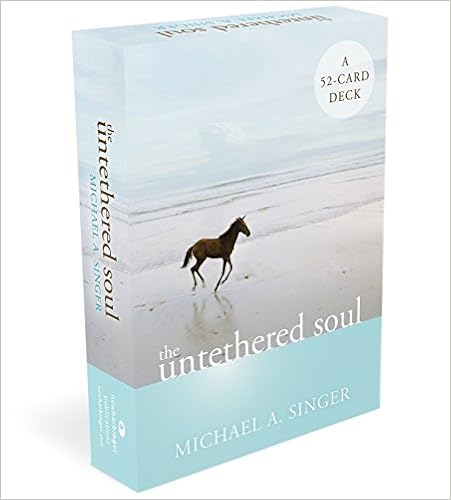
The Untethered Soul card deck from Michael A. Singer, based on his book of the same name, caught my attention as perhaps a more secular version of this interest. These 52 cards have short phrases to inspire and help center readers.

First off, the box and cards are very well made and beautiful in their own right. It doesn't feel like a cheap paper or cardboard container or deck set. It's something that looks nice on a desk, which is exactly how I use this one. I put the lid on the base at a 90 degree angle, providing a background and display a different card each week.

The image backgrounds have a good nature basis that can be used for contemplation and almost automatically provides some relaxation. The phrases, grouped into themes, can be encouragements, inspiration, or even questions encouraging reflection. One could easily just read through all the cards and move on with life, but that would miss the point. Sitting with them for contemplation and centering work is where they're useful.

As I suspected, they do have a more secular feel in many cases. However, some cards draw from various religious traditions, albeit lightly. If someone wants encouragement from a single tradition, you'll probably want to pass on this set. However, if you're open to considering wisdom from around the world, the phrases and considerations can be a useful foundation for contemplation and meditation.

The deck's trailer provides a bit more context:


This video makes the deck seem quite new age-y/self-help-like, and it can have that feel (positively or negatively, depending on your perspective). However, I have to say I think the promises in the video are more than a bit over-stated. No card deck or phrase will be truly transformative on its own. If you view the deck as an opportunity to remind yourself to be present and reflect, then it can be useful. But the sayings aren't necessarily any more inspirational or transformative than other decks. In fact, the lack of a firm spiritual tradition or psychological rootedness may make the deck and phrases appear to have less depth or "thickness."

In any case, this can be a nice gift for a loved one or even yourself. The benefit of it not being overtly spiritual is it can be used as a gift in many contexts.

Disclosure of Material Connection: I received this card deck free from the publisher. I was not required to write a positive review. The opinions I have expressed are my own. I am disclosing this in accordance with the Federal Trade Commission’s 16 CFR, Part 255: “Guides Concerning the Use of Endorsements and Testimonials in Advertising.”

This page contains affiliate links. If you make a purchase through this link, we may receive a portion of the sale at no additional cost to you.

Saturday, December 15, 2018

12 Practical Celtic Spiritual Activities (Book Review)

The Celtic traditions have long held deep meaning for me. There's something about the Incarnational and holistic approach that makes it theologically and practically impactful and relevant in my mind. I have been a reader of Christine Valters Paintner's devotionals and work for a few years now, and love her spirit and wisdom.

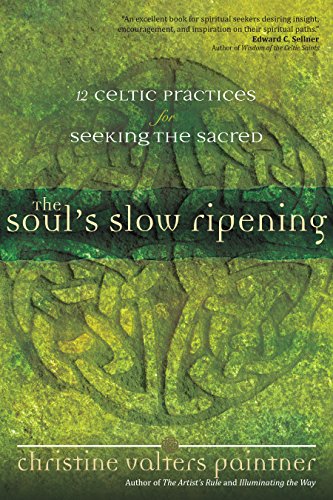
All of this made me interested in her newly released book, The Soul's Slow Ripening: 12 Celtic Practices for Seeking the Sacred. What is unique about Paintner's approach is that she provides a personal spiritual story, some historical background, biblical reflections, and concrete spiritual formation-type activities, including lectio divina and even photography, to help bring these practices home.

I also appreciate that her husband, John, regularly contributes to the reflections and applications of the practices. Another voice and perspective, albeit aligned nicely, bring additional context and wisdom to the text.

Paintner explicitly states that this book can be read from front to back, but also can be digested in any order desired. It really is that flexible, allowing the reader to dive into whatever practice is most relevant at a given moment. The subheadings and different aspects presented to each practice not only make them more concrete and readily applicable, but also provide easy moments to pause in readings and pick back up.

This isn't necessarily a book that one would read once through for lessons, although it could be used that way. Rather, it could be more of a reference tool, being picked up at different phases of life for wisdom and spiritual suggestions. There's enough variety and diversity that I can see it being useful in many contexts and phases of life.

It has enough philosophy and theology that it can have meaningful depth for those desiring traditional substance. It also has excellent practicality that it doesn't feel too "spiritual," abstract, or philosophical. The Paintners both come across as very practical to me, striking an excellent balance between Heaven and Earth.

If you're interested in Celtic traditions, this is an excellent addition, either for early explorers or even those seasoned in Celtic Christianity and spiritual formation.

Disclosure of Material Connection: I received this book free from the publisher. I was not required to write a positive review. The opinions I have expressed are my own. I am disclosing this in accordance with the Federal Trade Commission’s 16 CFR, Part 255: “Guides Concerning the Use of Endorsements and Testimonials in Advertising.”

This page contains affiliate links. If you make a purchase through this link, we may receive a portion of the sale at no additional cost to you.

Friday, December 14, 2018

Book Review of Brother John: A journey for meaning

A book as a contemplative spiritual experience. That would be my summary of August Turak's Brother John, a formally published and beautifully illustrated version of an essay for which he was awarded a Templeton Prize.

While many contemplative and meaning-focused texts can be quite philosophical and/or self-help-like, Brother John is an excellent example of spiritual story telling. The fact that it's a true story makes it all the more powerful. Turak's story telling is a perfect example of a spiritual biography that can inspire and encourage.

Turak provides spiritual and philosophical reflection and insights without feeling preachy or heavy-handed. He shares his story. He shares his reflections. He shares his conclusions. He offers them to the reader in case they're helpful. I think most people will find them meaningful.

A big differentiator in the text is the addition of paintings throughout the book from Glenn Harrington. Here's a preview from the trailer:


The paintings helped me slow down and engage the book as a journey. I can easily tend towards scanning texts to gain the basic points of knowledge trying to be conveyed. That's the not the point of this book, at least from my perspective. It's meant for us to reflect. Hearing Turak's personal story gave me a sense of peace after reading and motivated me to personally engage in some slower contemplative activities that I tend to put off for achievement-oriented activities.

Overall, this book felt less like reading a book and more like an experience. It's short, so it can easily be read in a single sitting, easily less than 30 minutes. But the insights will stick around longer. And I believe it's a book with visuals that one could easily come back to repeatedly.

I have to note that I also love that Turak has given the rights and proceeds from the book to the Self Knowledge Symposium Foundation (SKSF), a group he founded with his prize to help build meaning and purpose throughout the West, especially in colleges. Buying the book not only provides the reader with spiritual wisdom, but can also financially support others' journeys as well.

Disclosure of Material Connection: I received this book free from the publisher. I was not required to write a positive review. The opinions I have expressed are my own. I am disclosing this in accordance with the Federal Trade Commission’s 16 CFR, Part 255: “Guides Concerning the Use of Endorsements and Testimonials in Advertising.”

This page contains affiliate links. If you make a purchase through this link, we may receive a portion of the sale at no additional cost to you.

Monday, June 6, 2016

Review: The Sanctity of the Mundane


This review first appeared on the Englewood Review of Books.


Rob Bell, in his latest book, How to Be Here, explores how to create a life worth living through being present in the here and now. It addresses ideas that are becoming quite popular, likely because of their relevance for our modern culture and way of living. Bell continues with his strong, engaging writing style and story telling, so fans of his approach will likely appreciate this text, as well. His style should open up ideas to new audiences. At the same time, the book could be better organized to make his point clearer and send the message “home” more effectively.

As noted, Bell provides his usual writing that is engaging, accessible, and engrossing. His passion comes through clearly, and the personal anecdotes enliven abstract ideas. The short sections make the text easily digestible while allowing for pauses in reading, when needed. He is an incredibly effective story teller, and his success in many areas reflects this skill. It is once again displayed very well in How to Be Here.

The biggest challenge in this particular book is that, in many ways, it feels like a collection of short essays that are loosely connected, but could really stand on their own. I frequently found myself asking, “What is his point? Where is he going?” I struggled to find an overall thesis and direction. The book is subtitled A Guide to Creating a Life Worth Living, although interestingly, that subtitle doesn’t appear on the cover to provide some clarity. In hindsight, the title does summarize the thesis and purpose of the book, mentioned above: Create a life worth living through being present in the here and now. However, there are several sections that dive into other sub-theses and concepts, like ikigai, a Japanese word for what gets you out of bed in the morning, motivated to take on the day. There are great ideas and discussions he presents, but they don’t feel fully realized over the course of the entire book. This is what contributes to that essay anthology feeling.

A short introduction providing a direction/thesis and tying all the parts together would have done wonders for the coherency of the narrative across the entire text. On the other hand, Bell's style traditionally tends to be conversational, and his ultimate point isn't often known until his work is done. This works well for his short Nooma videos or even longer sermons. A book is a different experience, though, and making a clear direction, even if the conclusion is still a surprise, is really critical for reader engagement and comprehension. He also doesn't go back and clearly connect all the dots on the backend, which would at least have provided retrospective coherency.

All that aside, the points he was trying to make were strong. In many ways, the text reminded me of a modern version of Brother Lawrence's Practice of the Presence of God. Bell illustrates this very well, in his unique, engaging style, emphasizing examples of and the power of being present in the moment, seeing the sanctity of the mundane, helps us experience life more fully and find meaning.

Indeed, there are many faith and cultural traditions, within and without Christianity, that have taught these lessons. The behavioral sciences have picked up on these principles in the past decade, generally describing them under the umbrella of mindfulness, and plenty of research has reinforced the truth of these claims. From that perspective, there isn't much new in Bell's text, although he doesn't necessarily claim that he is coming up with a new idea. In many ways, he is a story teller to illustrate and convey principles in new ways. And Bell has always been excellent at this. This story telling to bring abstract principles to life is what How to Be Here does best. 

At the same time, the book full title: How to Be Here: A Guide to Creating a Life Worth Living is misleading, as it isn’t really a guide, at least not in a traditional sense. There are no steps, no real recommendations; just stories. A reader could easily walk away from the book wondering what they can really do to be here. Bell’s stories have examples, but they’re highly contextualized and therefore not necessarily generalizable. There are plenty of more concrete guides to mindfulness and presence that lay out example activities, prayers, exercises, etc. that can help us be more mindful and present in the moment. A potential downside of these materials is that they can be viewed prescriptively and formulaically, which is definitely a problem.

Perhaps this is why Bell takes a different approach. In reflection, an implicit part of his message seems to be that there is a journey, a story, to being able to be effectively present and create a life worth living. His initial and most enduring metaphor is in writing a story of our lives, starting with the blinking line on an electronic page. There is great truth to this approach, and frankly, I think it is truer than any activity, exercise, or form of prayer, as it is frequently in the doing of things that we lose our presence and sense of meaning. Yet many people need some examples of things to do to practice this sort of thing. Bell’s book can be complementary to these other, more traditional guides, with them providing practices, while he helps build motivation and weightiness to value of such practices.

In the end, How to Be Here is a book with meaning and value, but it doesn’t sit on its own well. Additional structure to orient the reader what the purpose of the book is, and ensuring all points are clearly connected would have strengthened it significantly. As it is literally advertised as a “how to” book and a “guide,” reference to other resources would have helped, as well. Even explicitly discussing the power of narrative and journey over practices, as I noted above, would have helped improve Bell's thesis and purpose.


This text is probably best for people who don’t necessarily need suggestions on what to do different (many of us know what to do), but need reminders of priorities and that mindfulness and presence is really quite worthwhile.

Disclosure of Material Connection: I received this book free from the publisher. I was not required to write a positive review. The opinions I have expressed are my own. I am disclosing this in accordance with the Federal Trade Commission’s 16 CFR, Part 255: “Guides Concerning the Use of Endorsements and Testimonials in Advertising.” 

Monday, February 24, 2014

Meditating on the Names of God

Names can be powerful things. Those of us how have children can all probably relate to how much we thought and debated about what word they would be labelled with the rest of their lives as central to their identity. Lucky for God, He wasn't limited by just one name. :)

I've seen many short devotionals and works of art based on the many names of God. In his short book, Your Great Name: Discovering Power for Your Life in the Awesome Names of God, Michael Neale explores some of the names of God used throughout the Bible and based on his song, Your Great Name.

For well-studied biblical scholars, there probably isn't much new information, but I don't think that's how this book is meant to be used. Texts like this remind me that worship and being in awe of God isn't necessarily just about getting information and understanding. Sometimes it's simpler, just hearing the names of our Lord and meditating on them. Frankly, being able to listen to a short audiobook, taking a break from having to be as critical of a thinker, actually helped me feel more connected to God.

Disclosure of Material Connection: I received this book free from the publisher. I was not required to write a positive review. The opinions I have expressed are my own. I am disclosing this in accordance with the Federal Trade Commission’s 16 CFR, Part 255: “Guides Concerning the Use of Endorsements and Testimonials in Advertising.”

Wednesday, August 3, 2011

Margaret Wills Guest Post: The Last Will Be First, Part 2


A few weeks ago, I reviewed Margaret Harrell Wills' amazing book, Pressing Into Thin Places. After that post, she graciously agreed to write a guest post for Jacob's Café. The second of the two part guest post is below. Click here for the first part.
________________________

There was a purity of spirit and generosity about Jimmy. Even though he planted the apple tree, he knew the apples were there to share. Jimmy was unpretentious and unencumbered by feelings of superiority or the need to make comparisons. It was not in his nature to shut people out, to judge because someone looked or thought a different way. I realized that I was not so generous.

I was different than Jimmy.

I began to think of prideful, self-righteous Ruby Turbin in Flannery O’Connor’s story, Revelation. Ruby had everyone in town categorized according racial, social or economic status. She had a sliding caste scale of sorts which determined, in her mind, how valuable, how important everyone was. Ruby, of course, had a tremendous degree of self-satisfaction regarding her position in the world. One time she broke out into ecstatic praise thanking Jesus as she thought about all the lesser people she could have been instead of herself.

It happened one day when she was out on her farm feeding her pigs. She was conversing with God when she was overcome with a vision, a revelation; a vast parade of souls was marching to heaven. In the front of the line singing and leaping and clapping were all the people Ruby looked down on. There were the poor, the poor in spirit, the unenlightened, the uneducated, the downtrodden, the misfits, and the mentally impaired. Yes, ahead of everyone else were all the poor souls who were last in Ruby Turbin’s caste classification. She stood transfixed, staring at the procession of people until she spotted herself and her husband Claud…trailing far behind.

Flannery O’Conner describes the scene:

“And bringing up the end of the procession was a tribe of people whom she recognized at once as those who, like herself and Claud, had always had a little of everything and the God-given wit to use it right…They were behind the others with great dignity accountable as they had always been for good order and common sense. They alone were on key. Yet she could see by their shocked and altered faces that even their virtues were being burned away.”

Flannery O’Connor
Revelation


Sometimes our virtues are burned away in the light of a revelation. I thought about Jimmy. I remembered the words of Jesus who said, “The last will be first and the first will be last.” And then I thought how we often breeze through life looking down on others; Looking down, without thought, on people whom we have categorized as less spiritual, less bright, less sophisticated, less prosperous, less educated, less clever that we. We shut them out before we ever sit across the table from them… God, forgive me. Let me move at least a little way up in the line. See in me,You, and not Ruby Turbin.

Tuesday, August 2, 2011

Margaret Wills Guest Post: The Last Will Be First, Part 1

A few weeks ago, I reviewed Margaret Harrell Wills' amazing book, Pressing Into Thin Places. After that post, she graciously agreed to write a guest post for Jacob's Café. The first of the two part guest post is below.
________________________


I first met Jimmy on a Sunday afternoon. He sat across from me at my sister Betsy’s dining room table. Betsy had invited him to join our family for after church dinner. Jimmy is an intellectually challenged, middle aged man. He was a healthy three-year-old little boy until Rhyes Syndrome took him a hair’s breadth from death and left him with a life of mental impairment, severe headaches and seizures.

Jimmy wore nice dress pants, a sport coat, a white shirt and a blue clip-on tie. The tie had a few small spots on it from other dinners. Onto the tie Jimmy had a prized possession; a rather large Noah’s ark tie pin. He was proud of the pin which he pointed to and mentioned several times.

Jimmy was not bad looking. In fact, just seeing him, you might have thought he looked like, business man (minus the spots on his tie). But when Jimmy talked, you knew. You knew he was different. His speech was halting and slow. It sometimes seemed he had to push his words out with a bit of added effort.

Jimmy could carry on a limited conversation and sometimes he talked about God. It was reported that Jimmy once went to a Christian music concert and the whole time had his hands raised in the air, singing and swaying to the songs as they were sung. He also once took notes in church while the preacher was talking and ended up with something that had nothing to do with the sermon. He did manage to write down the word Holy Spirit. He insisted on showing his notes to the preacher after the service.

Jimmy had a naive innocence and purity about him, a sense that the world was good and fair because he was. One time Jimmy said he was going to plant apple trees in his front yard. His friend asked him what he was going to do if people came and stole the apples from his tree. He thought a moment like he could not grasp the concept of someone stealing. Then he said he would put a sign out that said, “Share.”

At the table that day he fretted about the fat that was on the meat he was eating. He poked at it saying he didn’t eat fat because his mother told him it was bad for him. He informed us he could recognize fat by just looking at it. He was noticing fat. Once he spotted some, he took great effort in whittling the fat away from the meat. Our conversation lingered for a while on the fat on the meat and the fact that he could make spaghetti all by himself. He said he made good spaghetti. He emphasized and drew out the word the g-o-o-d.

Suddenly, out of the blue, Jimmy, in his slow deliberate way, made a pained statement. With a raised voice he blurted out, “I need a girl. “You want a girl?” my sister Betsy said. ”Yes, I want a girl real bad,” Jimmy replied. He then said that he had a girl once. “You had a girlfriend?” I asked. “Yeah,” Jimmy responded and then, in his halting speech, he said, “I had a girl once and she died. We asked Jimmy what happened to her. He got a grieved look on his face, his eyes narrowed and his forehead began to collect deep furrows. “I don’t know,” he said, “She just got sick and then she died real fast. I loved her. I loved her whole lot.” Jimmy said as he dragged out the words whole lot.

Jimmy then began to tell us in his slow cadence about his love for the girl. “I gave her a necklace, I gave her flowers, I gave her a ring. I really loved her. I was going to marry her. The word marry lingered long on his lips. “You don’t give a ring and flowers to a girl unless you really love her,” Jimmy said in a reflective voice. “She died,” Jimmy said again. “Do you have a picture of her?” Betsy asked. Jimmy said he had a picture of her on his dresser at home but he was saving her in his mind.

I wanted to leave the table, or just put my head down and cry for Jimmy, and his grief that had traveled over the miles of time and stayed, stayed in this gentle man, like a disturbing dream that lingers in the early morning.

Jimmy suddenly announced he had a bad headache. We asked him if he wanted some Tylenol but he couldn’t decide. Then we asked him if he wanted to lie down. “Yes, Jimmy said, “I want to lie down on a bed.” We found a bed and Jimmy went to be by himself. I wondered if he slept and if, in his sleep, he forgot about his memory of grief. Or perhaps he lay down and dreamed of the girl he loved; the girl he gifted with a necklace, a ring, and some flowers. A man needs a woman. God knows that. Jimmy needs a girl. He has a ring and some flowers and a heart to give to a girl who is waiting for a boy to really love her.

Monday, August 1, 2011

Richard Foster House Party @renovareusa

Long time readers of my blog know that I love Richard Foster's work, especially Streams of Living Water. On September 10, My wife and I will be hosting a house party for the release of Foster's new book, Sanctuary of the Soul. We will have a time for discussion, fellowship, and even a conference call with Foster. More information is available on the Renovaré website. We'd love to have you there. If you're interested in coming (there is no cost unless you want to buy the book), let me know!

Saturday, December 11, 2010

Prayer Books Summarized

This week, I have reviewed seven rather different prayer books. If you missed any of them or would like a summary with links, here you are!

Celtic Devotions: Based in the Celtic Christian tradition with short morning and evening prayers and devotions. Portable and useful for individual use. Could be used in a group.

A Pastor Prays for His People: Developed and transcribed from a pastor's prayers over the years for his congregation during weekly church services. Has an index of themes. Probably more useful in a group setting. Good portability.

Prayers: A Personal Selection: A short audiobook of prayers from the Bible and from Church history set to music. Particularly good for individual meditation time.

Common Prayer: A Liturgy for Ordinary Radicals: Thick and dense book rooted in the long history of liturgy from several Christian traditions, making it quite comprehensive. Included is a songbook, making it quite unique. Focused primarily on a contemplative tradition. Not as portable as some. Could be used individually, but more useful in a group.

Light for the Journey: Morning and Evening Prayers: Written with a goal of becoming more active participants in our lives and with God to renew the world. I received a PDF version, so I cannot comment on portability, but it is like mobile. Could be used in both an individual or group setting.

Eucharistic Prayer for Inclusive Communities (Vol. 1 & 2): Coming from a feminist Catholic perspective, the editors bring together "high church" liturgy from worldwide authors for use in group while celebrating the Eucharist. A unique element is using gender inclusive (and often female) language around God. It comes in a spiral bound version that lays flat for easy use. I received a PDF version, so it is difficult to know the dimensions, but they appear to be 8.5x11.

BodyPrayer: Focused on a more Incarnational tradition, emphasizing the role of our bodies in prayer, reminding the reader that the body is important to holistic spirituality and prayer. Very mobile and can be used individually and in a group.

Tuesday, November 30, 2010

UPDATED A Bracelet to Remember to Love + GIVEAWAY @mendmark

Read to the bottom to find out how to win a FREE Mend Mark bracelet!

Through one of the organizations from which I receive review books, I received a press release about a product called Mend Mark. It's a rubberband-like bracelet with a goal of reminding us of Christ's sacrifice in order to remind us to love others. The bracelet looks (and feels like a bracelet) with two small circles on opposite ends that when worn, remind me of the stigmata. Further, some of the proceeds benefit Living Water International to provide clean water to people around the world.

I loved the idea, and so I was able to get one to review. The first thing I noticed was that it was smaller than it looks in the pictures. This is actually a good thing because it makes it subtler and more ambiguous, which I like. As the creator, Hunter Harrison, noted, his goal was to make something that people would have to ask about to know the meaning (rather than assuming the meaning). As this blog often emphasizes the problems with assumptions, I like this idea. Plus, personally, I tend to like subtle symbols.

Despite it being subtle, it was unique enough that a few of my co-workers noticed it and asked about it. They all thought it was awesome. One wrote down the website to look into getting one. This could make the bracelet a nice way to evangelize, both to non-Christians and Christians (it's important to remind everyone to love everyone more!). One of my colleagues thought it was a tattoo at first. This is interesting because Harrison made this in place of getting a tattoo.

Wearing it did help me remember to be present and focus on Christ and loving others. The bracelet is also embossed with "Remember Love," one word on each of the circles. The words were rather small, making them more of a subtle reminder than a blaring bullhorn of a symbol. This made it a great contemplative tool to be present in the moment, recalling Christ's sacrifice, and remembering to always love others. These are, of course, excellent things to focus on.

Now to the downsides. It was rather tight. I definitely had a red mark after wearing it. But it didn't hurt. A little extra space would be nice, though. Unfortunately, as I took it off my wrist after the first day of wearing it, I stretched it too much, and it snapped. The packaging reminds users to not stretch the bracelet too much. I was surprised how easily it broke, though. I would have needed to roll it over my hand rather than stretching it over. Considering the popularity of the Silly Bandz (and just experiences with generic rubber bands), I'm sure another form of material could make it more elastic (or maybe make different sizes).

If I had purchased one at $9.99, I would have been very upset (I'm sad anyway, as I would really like to wear it regularly for quite a while--if anyone has ideas how to mend the Mend Mark, let me know). Honestly, it seems quite over-priced. I doubt the manufacturing costs much (again, look at the number of Silly Bandz and their generic forms that come in packages that much less). The impact cost is offset a bit by the fact that proceeds do help a great organization. But still. The packaging was incredibly impressive and possibly cost more than the product itself. Making a cheaper package could have reduced the cost much more.

Considering the ease with which it broke, I doubt I will purchase a new one. If it were of higher quality or cheaper, I'd consider it. It's a great idea that really helped me be present and remember to love others... for a day. But lasting only a day isn't so good. Maybe a fabric elastic attached to two circles so they stay firm to the wrist could achieve the same purpose while not being as tight and being sturdier...

UPDATE 12/3/10: I heard back from the person who sent me the review copies, and she said that she has not encountered any other incidents of the bracelet breaking, so mine is hopefully an isolated incident. She is also sending me a replacement, which I would hope they would do in other circumstances, too. :)

In any case, I also received a Mend Mark to give away here on the blog. In order to enter, leave a comment saying why you would like a Mend Mark. You can get additional entries by (1) following me on Twitter, (2) retweeting my Tweet about this post, and (3) subscribing to my blog by email or RSS. Leave a comment on the blog letting me know you did these (if you already follow me on Twitter or subscribe to my blog, that counts). The contest will close on Friday at midnight. I will need a way to contact you, so either leave your email address, subscribe to the comments feed, or check back here.

If you would like to know more about Mend Mark, below is a Q&A with the creator from the press release.


Q&A With Hunter Harrison,
Creator of the Mend Mark

Mend Mark bracelet.jpgQ: How did you arrive at the idea for the Mend Mark? Why a bracelet? 

A: I always thought about getting a tattoo. I still haven’t, but tattoo designs frequently cross my mind, and if I ever got one I would want it to be meaningful. On one particular day, I had the idea of getting two circles tattooed on my wrist to resemble a hole. But not just any hole—the hole that killed a king. The more and more I thought about it, the more I came to realize that nowadays EVERYONE has a tattoo and it would almost be rebellious NOT to get one. (I guess you could consider me a reverse rebel.) So I decided to do something a little different, something that would reach many more people than just some ink on my wrist. I took the idea and designed a bracelet instead, and consequently, the Mend Mark idea was born.

Q: At first glance Mend Mark seems like a nebulous name. What does it mean?

A: I’ve always liked the word “mend” and I feel like it’s underused. So it was an easy decision to incorporate that into the name. It fit the product purpose, and since it was representing one of the marks of Jesus, Mend Mark was an obvious choice. Plus it had a nice ring to it and with tattoo roots it seemed natural to call it that. I wanted it to be more than just another bracelet or wristband. I wanted it to represent a movement. So the “Mend Mark” it became.

Mend Mark open package.jpgQ: What are you hoping will be accomplished through the wearing of the Mend Mark bracelet and through the Mend Mark movement?

A: There are three main things I want to be accomplished. First is that I wanted people to remember the sacrifice. I wanted to unite people—Christians (no matter the denomination) and even people of other worldviews—on one common message: LOVE. The love that Christ preached in particular. With so many books out there and theological debates on who’s right and who’s wrong, sometimes we forget the simplicity of Christ’s main message: LOVE. I figured that no matter what one believes, they can’t deny that selfless love can change the world… and sometimes we need a reminder of that. So I coined the phrase “Remember Love” to be printed on the bracelet. The second thing is that I wanted people to emulate the emotion. I wanted it to require the wearer of the product to engage in conversation about the love of Christ (and hopefully show that love to others) instead of just letting the product talk for them. I felt that if this was done properly it could force people into intentional situations where they were able to demonstrate their faith. If I was a non-believer and I saw someone wearing an obvious Christian product, I doubt I would ask that person about it because I would already know what they were going to say. But, if I saw this, I would want to know what it was. It sparks curiosity… and in turn that curiosity may open some doors for people to share the love of Christ with others. Finally, I wanted it to inspire people to change the world around them. I decided to find a cause to support through the sales of the bracelet. There was no reason for me to keep all the profits for myself. I wanted to be able to give back and share the proceeds somehow. I researched and prayed and petitioned God on what ministry to support and God led me to Living Water International. I knew I wanted to help fight malnourishment in one way or another and providing “Living Water” seemed to fit the purpose of the product—using “love” to mend. That’s what it’s all about and this product allows that to happen on a global scale.

Q: Where did the inspiration to create the Mend Mark come from?

A: My mother was the most influential person in my life. She raised me on her own, even homeschooled me in high school, and I think that extra time with her really impacted me. She passed away from cancer in 2007, but she always told me I would do great things. My wife, Morgan, has been extremely instrumental in encouraging me to take those words from my mom to heart and make them a reality. Morgan motivates me like no one else can and has been a tremendous source of love and support throughout the entire process.

Then my work in banking inspired me. All day long I am helping people achieve their dreams getting businesses and ideas started. I wanted to get out there and start doing something myself. But I wanted it to be meaningful. Since my son was born two years ago, he’s given me an added motivation to do something bigger than myself, something that will somehow leave a legacy behind.

Q: The Mend Mark is certainly growing as a movement. It’s even been worn by celebrities. What’s next for the MendMark?

A: The Mend Mark isn’t the first idea I’ve tried to get off the ground. It definitely won’t be the last either. By far, it’s been the most fun and the most successful, and the one I’ve been most passionate about. I’m currently working on additional product designs as well as T-shirts that will go along with the original Mend Mark purpose. The future is bright and I can’t wait to see where God takes it.
Friday, May 7, 2010

Calming Celtic Devotions @ivpress @ivpbooks

This review was made possible by a complimentary copy of the book from InterVarsity Press.

As many people who know me well know that I love all things Celtic, particularly Celtic Christianity, I was very interested when I saw Celtic Devotions by Calvin Miller in a bookstore.

The book is meant to be a 30 day devotional to lead the reader in morning and evening prayers. Physically, it's an easy book to carry, which makes it effective for its intended use. It's small in all dimensions, but has a hard cover, which is nice to protect as it is carried or moved.

Each chapter for the 30 days includes a devotional reading to set the day up and then a morning and evening reading and prayer. The book uses Psalm 119 as its core, which Miller explains is because this Psalm is central to Celtic spirituality. I like the use of this kind of core because it ties all the chapters, devotions, and prayers together.

The chapters and prayers are short, making it easy to use the book for a quick morning and evening devotion. The incarnational element reinforces what I love about Celtic spirituality.

If you like Celtic Christianity or want to get into a rhythm of daily prayer, this is a nice book to use. It's nothing that will be shockingly new, but that's the beauty of it. So often I try to use my time and reading to learn and engage new things, when in fact, I probably need to slow down. This book encourages just that.

Wednesday, March 17, 2010

Not-So-Imaginary Jesus @caReviewers

The next book I have reviewed for the christianaudio Reviewer's Program is Imaginary Jesus written and narrated by Matt Mikalatos. As should be obvious, I did receive a free copy from christianaudio in exchange for reviewing it. As followers of my blog know, my other reviews of their works have been less-than-stellar (I wish they'd choose other options for review because they have a lot of great texts, er audio). So this positive review should emphasize that this is not an over-inflated review due to getting a free audiobook. :)

Imaginary Jesus caught my eye due to the title and the synopsis. It looked creative and in my interest area because of the idea that we have constructed a Jesus in our minds that clouds the real Jesus. That is precisely what this book discusses, but not in such a bland and boring way as I just described it.

Mikalatos (who does an excellent job narrating--I particularly love when authors narrate their own works, especially when they are of such a personal nature) does a very creative job tackling (sometimes literally) his imaginary Jesuses, guiding us through his imagination in what many ways makes this book feel like a novel. I must say that about an hour or so into the book, I got a bit bored with the Jesuses, but this gave way to appreciation. Without these descriptions, the final chapters, which were more propositional (although not terribly explicit), would not have been as powerful. The chapter, "Holy Mother of God," was particularly moving, I thought. I don't want to give too much away because the process of moving through Mikalatos' imagination is part of the power of the book.

In many ways, this reminds me of the mystical texts that some of the saints used to describe their inward journey to meeting Christ. Mikalatos takes a more humorous approach. However, it is funny because it is terribly accurate (in particular, I loved the Secret Society of Imaginary Jesuses). He does an effective job of crafting a modern mystical experience that is at once both individually contemplative and communal.

Further, I realized toward the end of the book that this is a perfect example of describing God image. This refers to the construction of God we have created and with which we interact. It's a natural psychological phenomenon everyone does with anyone with whom we relate. It can be a hard concept to understand, but this book makes it much more understandable.

In sum, I highly recommend this book. I'm not sure how it would be in written form, but the audiobook is excellent. In many ways, I the audiobook may be better if for no other reason than the author reads it himself. That conveys a message no written text ever could.

Questions?

Got a question, struggle, or doubt you'd like to see addressed here? Contact me, and I'll try to discuss it (and may even help you get an answer).