Showing posts with label Technology. Show all posts

Monday, June 22, 2015

Muse: Technology-Assisted Mindfulness

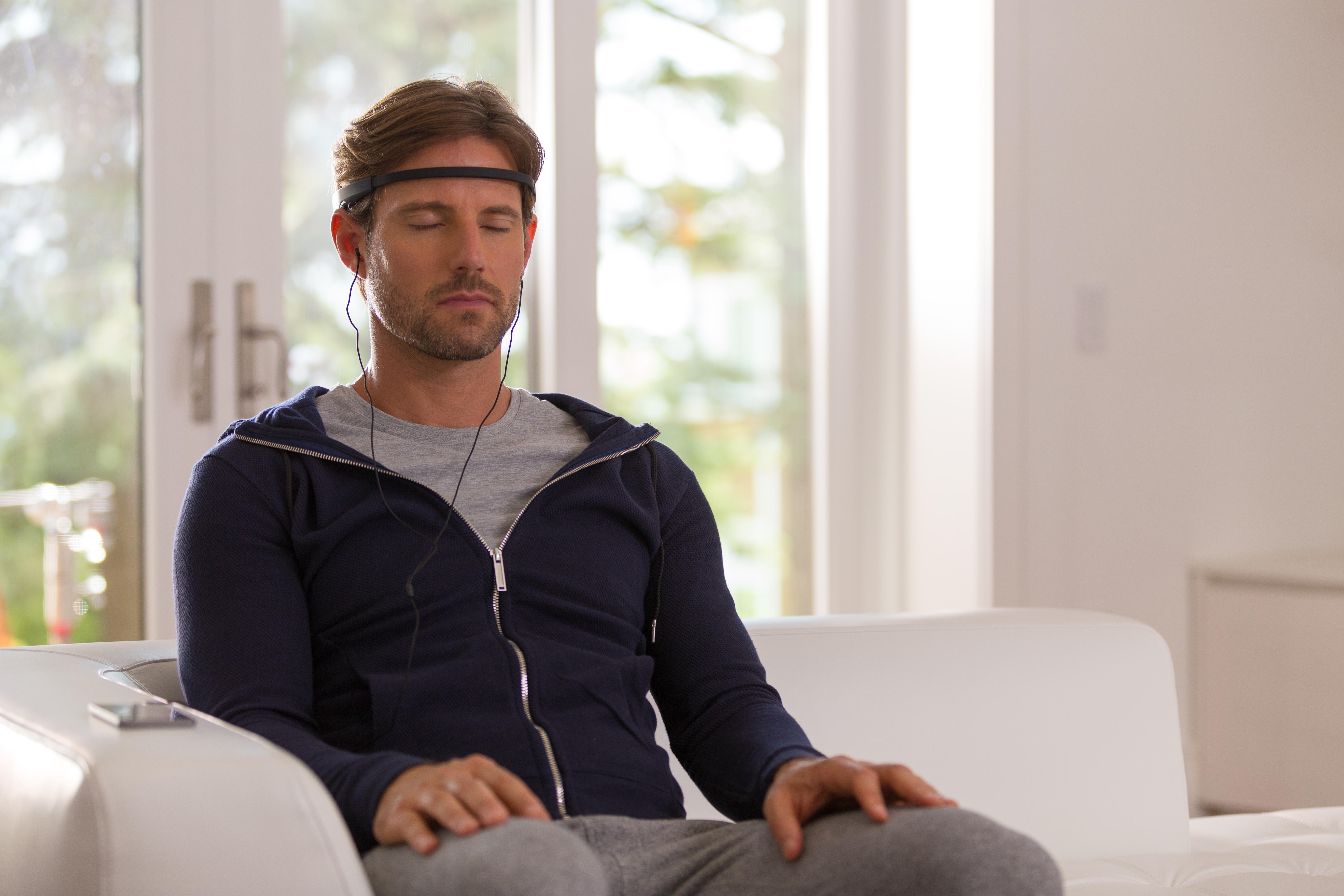
The Muse is a relatively new product, dubbed the "brain sensing headband." InteraXon, the company behind Muse sent me a Muse to review. I also had the opportunity to have a short interview with InteraXon's co-founder and Chief Product Officer, Trevor Coleman. Below is a thorough review of the device and its application. It starts with some background on mindfulness and neurofeedback, so skip ahead if you're familiar with these topics.

Background
Mindfulness is all the rage. Corporations are promoting mindfulness at work, and mindfulness-based therapies are the focus of regular research in the behavioral health world. I've seen the benefits first-hand, being intensively trained in the mindfulness-centered Dialectical Behavior Therapy (DBT) and therefore regularly teaching and leading mindfulness activities. More and more people are also recognizing the congruence and benefits of spiritual forms of mindfulness to enhance their spiritual lives, as well (centering prayer and lectio divina can be considered forms of mindfulness).

For those unfamiliar, mindfulness has many different definitions and forms, but my oversimplified summary is essentially awareness of and being present in the moment. It has been shown to be helpful for things from depression, anxiety, and ADHD to improving relationships to enhancing one's spiritual life. There is a lot of overlap with meditation, which is in some ways a specific type of mindfulness, where one maintains attention on a single object, thought, phrase, etc. Based on my training and a sense that people are more open to the term "mindfulness" than "meditation," I tend to use the term "mindfulness."

A year or so ago, I explored neurofeedback for my department as a potential intervention we might want to consider. In short, neurofeedback is a form of biofeedback that uses EEG (electroencephelography) technology to provide feedback to a user about their brain activity. Biofeedback traditionally focuses on easier-to-capture biometrics, like heart rate, breathing, sweat level, and muscle tension, to provide immediate feedback to the user about physiological symptoms related to a variety of conditions. It has been particularly effective for anxiety disorders. Raising awareness of one's physiology, even parts that we cannot directly control (like heart rate), allows us to adjust (sometimes subtly and unconsciously) parts of behavior (including breathing, elements of attention, etc.) that help us become calmer and in turn impact the involuntary physiological symptoms that create conditions like anxiety. This immediate feedback reinforces new skills that help us better cope with emotional dysregulation, and these skills generally "stick" after therapy ends.

I see neurofeedback as essentially a more efficient way of reinforcing skills, especially around mindfulness. Brain waves are not something we can directly control, but our behaviors influence brain waves, which in turn influence behaviors. Changing some of our behaviors, such as where we direct our attention and how we breathe, impacts our brain activity, which reinforces calmer, more focused behavior. Some neurofeedback providers claim their systems directly change the brain. I have seen no evidence of this, and I view it as either a blatant lie to sell a product/service or ignorance on the part of the clinician (I'm not sure which is more dangerous, frankly...). This is an important distinction, as many people would be (appropriately) concerned about direct brain intervention.

The beauty of neurofeedback and biofeedback in general is that they help us become more aware of our bodies to aid us in shaping our behaviors and building new habits that allow to live healthier lives. It's actually a very natural, culturally sensitive, non-invasive way of improving all elements of holistic health, including physical, psychological, and spiritual.

Neurofeedback can be quite pricey, easily running at least $1500 for a course of treatment by a licensed provider (still cheap if it's effective). Some insurances cover it, some don't. But does all treatment, especially when it's focused on improving health rather ameliorating pathology, need to be mediated by a provider? What is appropriate to be done on your own? Health care providers regularly encourage at home practice of a variety of exercises that shape our behavior (think diet, physical exercise, relaxation exercises, thought records, etc.). Mindfulness is regularly "prescribed" as an exercise to practice on your own after some education about how to do it (which does not require any licensed provider). So why couldn't technology-assisted mindfulness be done on your own?

The Muse Method
Enter the Muse, the "brain sensing headband," which I see as essentially a $300 consumer neurofeedback device focused on reinforcing mindfulness. Now to be clear, this is not advertised nor meant to be a health care device or to take the place of any professional advice. It is "a brain fitness tool that helps you do more with your mind by helping you calm and settle your mind." InteraXon, the company behind Muse, has a long history of brain sensing technology integrated into consumer life.

InteraXon generally uses the term "meditation" in conjunction with the Muse, as it is currently based on maintaining one's attention on an object. When using the Muse, there is a one minute calibration to ensure the Muse knows what an active brain looks like for you (everyone's brains are quite different). Then you engage in a focus activity for a length of time you choose. The calibration and activity are done with eyes closed, and the instructions are to focus on your breath, a common mindfulness meditation that is also convenient as it can be done anywhere, as needed (we always have our breath with us!). The feedback portion is achieved through sound. There are currently two audio environments, one a beach with a windstorm, the other a rainforest with a... (wait for it...) rain storm. Coleman stated, anecdotally, they have found people who want to boost their mind use the storm, while those who want to relax use the rain. Interestingly, I prefer the rain, and my interest is really relaxation... The more you maintain focus on your breath, the calmer the sounds are. When your brain waves hit the "calm" region, you also start collecting birds.

The mindfulness reinforcement comes via calmer, quieter sounds when you are focused and increased storminess when you get distracted (quite parallel to how our brains can feel!). This can be a very effective way to raise our awareness of distraction. It is very easy to practice mindfulness and not realize you are distracted, so this is much more valuable than one might realize. While the storm can be very helpful in raising awareness of distraction, I found that over time I could sometimes tune it out (that was usually when I was quite distracted). More significantly, sometimes the storm made it harder to focus on my breath and could lead to frustration with not getting calmer. Lowering the volume seemed to help a great deal. A recent app update gives much more flexibility in adjusting volume of different sound elements. I highly recommend trying out different volumes to find a "sweet spot" of what's most effective for you.

Coleman explained they are exploring additional exercises and feedback methods. That's the benefit of modern technology--software upgrades can provide a lot of new features for the same hardware. While there can be no guarantees, I wouldn't be surprised if some good new features are available in the near future with no new hardware investment required. I also recently took a survey that indicates InteraXon is considering a freemium model for the software features. This makes sense from a business standpoint, but after investing $300 for a device, I hope they continue to provide significant software enhancements for free. Coleman had mentioned they were working on a way of normalizing one's calibration over time so you wouldn't have to do the calibration each time and so it would be more accurate. This was also mentioned in the survey. This is an example of something that I would hope would be free. Things like additional audio environments, extra challenges, advanced analytics, and performance comparisons with other seem potentially appropriate in a subscription context. There is no indication that a subscription would ever be required, and the basic features are still very effective and strong.

My Experience and Tips
While there are basic instructions that are available for the sessions, I think I significantly benefitted from knowing a lot about mindfulness. I was able to coach myself through sessions having this background, which I'm sure improved my performance. If you find yourself struggling with maintaining a calm state, I recommend doing some reading/training on mindfulness and its principles, especially not judging your own performance. Remembering to gently move our attention back is helpful. I would at times get frustrated with having a storm when I thought I was focused on my breath. This, itself, emphasizes a benefit of the feedback--sometimes we're not as focused and calm as we think. I found when I reduced my tension and just tried to have a posture (physically and mentally) of acceptance, my mind calmed faster and birds came and stayed longer. Trying to force myself to focus was often counter-productive. I discovered my brain also would not immediately calm when I redirected focus back to my breath. While a storm would come quickly if there was a distraction (like a cat jumping on my lap or a toddler being a toddler), the storm would usually take a few seconds to calm. This, in itself, is a good life lesson and practice of patience...

The App and Technology
It's also important to note that while your performance will hopefully improve, you're competing against yourself. With the current method of calibration, if you're having a calm day, your baseline will be lower, so it will be more difficult to achieve a high calm state (according to the software's scoring). Longitudinal calibration, if released, will be very helpful for more effectively tracking one's practice and assessing progress and challenges. In any case, the scores are relative to yourself. However, this is still helpful, as a storm in even the calmest state indicates some level distraction.

While I didn't try it, it could be possible to use the Muse with other kinds of mindfulness activities, like visual focus. However, the calibration would then have to be done with eyes open (just opening one's eyes increasing brain activity significantly). I'd also be curious to try other types of focus activities, like a centering prayer, where a word or short phrase is repeated. I would guess it would be more challenging to achieve an official calm state with this type of activity, as there would probably be more brain activity than with just focusing on one's breath.

The Muse team does a nice job of encouraging regular sessions in a variety of ways. The presence of a current streak and longest streak of doing session every day in a row has been very effective for me not yet missing a day since I received the device. They also have a variety of challenges that get you to higher levels. For those of us with a competitive streak, this encourages improving our practices in a variety of ways. I would sometimes do an extra session just to get to the next level. While it took a few days to have the time available, I wouldn't have done a 40 minute session without this challenge requirement. And it was not as hard as I had expected (and surprisingly quite pleasant!).

Technologically, the Muse connects to a phone or tablet via bluetooth. The pairing process is easy, and I experienced no problems maintaining a connection. Sometimes the sensors over the ears take a little longer to establish a strong signal, but I found if I just patiently wait (always less than a minute), they connect. I can easily go a week before charging the device, which is easy, as there are two micro-USB ports. A recent app update that allows you to see the current battery level is very helpful. The app itself is good looking and easy to navigate. The one thing I don't understand is the requirement of the screen to be on during a session. For long sessions, keeping the phone/tablet screen off would be helpful to save battery life. This may be a way to keep the bluetooth connection alive or something, but it's strange. I originally thought I'd like using the app on my iPad, but since there is not visual feedback during a session, I only use it on my iPhone, which I ultimately prefer. A smaller device to hold or keep nearby during a session is easier.

There were a couple of problems I had with the app recognizing times and days, which affected challenge completion. One email to support, and I received a very prompt, helpful response. It turns out there was a bug in the app, which was quickly fixed in the next update. As many of us know, customer service, especially with technology products, is of utmost importance and can make or break a product/service. From what I saw, Muse is putting quick, friendly, helpful customer care as a top priority.

Conclusions
So is the Muse effective? I'd say yes. I've known for a long time I "should" practice mindfulness on my own outside of the professional context. But it was hard to get the motivation to do so. However, I quickly looked forward to and really wanted to practice with the Muse. For me, playing with technology in itself is fun and a reinforcer, but I do notice I generally feel calmer and more centered. My mood does seem to be a bit better and more regulated after I engage in a session. I'm also more aware of being distracted throughout the day, which allows me to bring my attention back to the present moment.

While $300 is not cheap, it is quite cheap for this type of technology and could be quite worth it for the benefits. It is not a magic device; you have to work and keep engaged in the activities. Coleman explained it takes about 2-3 weeks for most people to notice a difference and regular users settle into a pattern of sessions 4-5 times a week. 15-20 minute sessions are often the minimum to be effective based on their initial findings, although I find 7-10 minute sessions are helpful and easy to fit into my day.

One of the things I really appreciate is that InteraXon is doing solid research on the device. They have partnerships with some universities using the Muse in various projects. They also ask users to opt-in to share their data for continued improvement. Their privacy practices seem strong and appropriate, and I encourage participation. The more users who contribute their data, the better chances at seeing strong updates that will help us all. While no research is yet published, anecdotal evidence of benefits matches the values of mindfulness, including improved emotional regulation, sleep, mood, interpersonal interactions, etc.

No formal case comes with the Muse, although the hard plastic packaging works well (and is what I currently use, although it's bulky and awkward). There is an official Muse case, which sells for $40, and doesn't seem much smaller than the clear plastic sales packaging. From reviews I've seen, many people question the price-point. For $300, it would seem appropriate to have a case included. I definitely recommend keeping it protected in some format, especially if you travel with it (to work, vacation, etc.). A universal headphone case or something similar might work, as well.

If you think practicing mindfulness regularly would be a benefit to your life, then the Muse could be an excellent investment. I've been using it for more than 60 straight days (every day since I received it), for a total of over 760 minutes of practice, and I plan to continue to use it daily. I even took it with me on vacation because of its benefits.

For those interested in purchasing the Muse, it is available through Muse's website, Amazon, some retailers in Canada, and will be in US Best Buy stores in mid-July.

Disclosure of Material Connection: I received this item free from the manufacturer. I was not required to write a positive review. The opinions I have expressed are my own. I am disclosing this in accordance with the Federal Trade Commission’s 16 CFR, Part 255: “Guides Concerning the Use of Endorsements and Testimonials in Advertising.”

Sunday, December 12, 2010

Technological Contemplation & Presence @LifeDiscipler @FCStores

Since I read Present Perfect a few months ago, I've been looking for some way to remind myself to remain present intermittently throughout the day. In that book, Boyd talks about how he gives himself reminders to stay present and attentive to God. Staying present is something that is very difficult for me, as I can become easily distracted. I searched for some applications for my Android phone, but nothing quite worked.


Then a short time ago, in a Family Christian Stores brochure, I saw a listing for the LifeDiscipler. It is a little gadget that feeds you a Bible verse every 15, 30, or 60 minutes (of your choice). At the selected interval (and you can turn the device off completely), it beeps at a soft or loud volume (or you can silence the alert) to let you know you can read another verse.


In many ways, this is exactly what I was looking for, so I purchased one from a Family Christian Store. I currently have it set to 30 minutes, which feels generally perfect to help me remain mindful of and stay in God's presence. I would really love if it could have a vibrate setting. Working in a mental health setting where all devices have to be silenced, I simply have to leave the LifeDiscipler in my office. While I wouldn't be able to read the verse during a therapy session, just the vibration would help me remember to be present. Additionally, even the loud setting can be too quiet at times (I missed it going off doing some Christmas shopping). The vibration option could help prevent this.


They are developing iPhone and Android application versions of LifeDiscipler, so we may see the vibration feature there....


The other really neat benefit is that the 1500 verses from 5 translations (NIV, TNIV, NKJV, NLT, CEV) are broken up into 44 categories, so you can choose what theme you want to receive verses from. This helps meet individual and immediate needs more effectively.


The LifeDiscipler goes for $30 on the LifeDiscipler website, although they are advertising a 20% coupon code (CHRIST20) through December 17. They are offering a 30% off coupon code (LIFE30) via the Facebook page. Family Christian Stores had it for $25 when I purchased it, although it's on sale for $20 right now. Ultimately, this seems overpriced. The basic technology is simple, and the plastic does not seem like the highest-quality. However, it does not feel like it would break in the time I've used it. It seems more like a sub-$10 product, especially compared with various youth games with more detailed screens and controls. At the same time, the price seemed worth it to me for the benefit I got (although I almost didn't purchase one because of the price).


[I provided the creator of the LifeDiscipler with a preview of the review, and he provided this clarification of the product manufacturing process and resulting cost:
The LifeDiscipler is actually made with high density ABS (very tough plastic - more expensive as well) and the lens is protected by a polycarbonate lens (best clarity and most durable)... we selected the best plastic possible (the weight of the product is light and oftens gives the impression of a lesser quality part - so it's understood why you said that). And the price is a direct correlation to our cost and the volume we produce. Since we are a brand new company with one product, our product costs are much higher than a company that produces 50k units. Many of the games you mentioned started out at double their current retail price (like 20Q for example).
The LifeDiscipler is a way that emphasizes how technology can truly help us become more contemplative and practice the presence of God.

However, the name implies we can become a disciple simply by reading Bible verses occasionally. As I discuss on this blog, that's obviously not true. The packaging and website also advertise how it can provide life answers as we need them. I think that's an overstatement, especially as the verses are not read within the larger narrative. However, they are chosen well to be able to stand on their own as much as possible.

Nevertheless, I think the name is clever and fine. It's good marketing. And as long as we don't over-rely on any one tool, the LifeDiscipler can help us become better disciples by reminding us of God's promises, God's presence, and God's word. I will continue to use it on a daily basis.

Wednesday, September 8, 2010

Technology and the Presence of God

Yesterday, I reviewed Gregory Boyd's Present Perfect: Finding God in the Now. As I said in it, I particularly love the practice of the presence of God. I find focusing on the present very meaningful and important both psychologically and spiritually.

Traditionally, this spiritual discipline has not received a lot of attention. Perhaps that is because it is so simple (yet so complex). Maybe it's because in its simplicity and incarnational approach, it's not always explicitly "spiritual." And people like feeling "spiritual."

However, I also wonder if it has to do with a societal shift. In another book I'm reading on Celtic spirituality, the author noted that people's activities were often mundane, repetitive, and boring. They livened the activities up by creating prayers and praise songs to go along with the daily activities. In many ways, this is a perfect example of living in the present and seeing God's presence in all we do.

With technology, many of these mundane, repetitive tasks have become automated and literally mechanical. This is a good thing. We have been able to achieve so many wonderful things in the world because of these advances. However, with the advances, we are now free to focus our energies on more engaging tasks. These tasks are less boring and require us to truly focus on them. That makes focusing on something else (namely God) more difficult. It's easier to say a rhythmic prayer while churning butter, doing laundry, or cooking a meal than it is writing a paper, doing therapy, teaching a class, running meetings, etc.

Could this be part of the reason that (stereotypically) blue-collar workers can often have more vibrant spiritual lives than white-collar workers? White-collar jobs often feel like they can do more good for the world and more ministry-related than many blue-collar jobs (again a generalization and stereotype that could be the topic of an entire other post). However, these ministry-related jobs may be the things that are removing us from God more than anything else because they distract us.

We are often doing so much for God, but doing it without God by our sides...

Tuesday, March 16, 2010

Theology After Google Wrapup or Where's the Praise? #tag10

Sorry for the delayed wrap-up. I finally scheduled my first licensing exam, so the next two weeks will be extra focused on studying. But no more highly anticipated waiting for my final thoughts on the Theology After Google conference. :)

First of all, the third day was by far the best. It was less focused on convincing everyone to use technology and social media and more of showing people various ways of actually utilizing it. I also appreciated that there was less focus on technology as the end-point in contrast to it being a means to an end.

There were a few points that particularly stood out:

In his presentation, Doug Pagitt (whose writings I very much admire and who I was very excited to meet at the conference) discussed different "Ages" that America has passed through that have affected how the church operates. He noted that we have been in the "Age of Information," which has created a church that is all about teaching. I have discussed before the question of the emphasis on teaching in church, but this really helped pinpoint it, describe it, and put it into perspective, particularly that church (even the organization on Sunday mornings) can and should be much more than teaching.

He also describe a phenomenon that I've noted before about the differences between mainline/progressives and evangelicals. While I have described it as a cognitive/affective split, he named it as open minded and challenging one's own assumptions and theology versus challenging one's aesthetics and mode of presentation. I think we're hitting on the same idea: Mainline/progressives are willing to change their thoughts, but not their mode. Evangelicals are willing to change their modes, but not their thoughts. While there's exceptions to these rules, I find them largely true. The problem is, I still have not found a satisfying answer as to why this is the case.

Further, I'm really sick of this divide. My friend and I both noticed that there was evidence of a very strong divide between evangelical thought and mainline/progressive thought. The conference was sponsored by and dominated by the latter, and there were various comments and such that showed a disdain for evangelicalism. I still want something in between. As I shared in a breakout group, I'm currently going to an evangelical church. I can do the cognitive challenging stuff on my own (I do it anyway). I need the group for the praise element. For some reason, I find that that is something that I cannot do satisfactorily on my own.

In response, Doug Pagitt mentioned how he is out of the mindset of "the God of the gaps," referring to God is only present with what man cannot do. I completely agree with him, as readers of this blog should know. God works incarnationally. However, there is something important about occasionally being explicit and praising God. An analogy I thought of is marriage. I should show my wife how much I love her and live that out. However, I also need to say it out loud. And frequently. I think it's the same with God, for God's sake AND for mine. Probably more for my sake, as I'll forget why I'm doing something.

That's one of my biggest criticisms and complaints from the conference. There was a noticeable lack of praise. I called it "devotion and worship" before, but I realized "praise" is probably a better descriptor. I think that may be an artifact of the mainline/progressive tradition. This is what makes me feel more evangelical than I thought I was. Now interacting with many of the top movers of Emergent Village, I understand why some people, like Dan Kimball have separated and started their own organizations. I don't know or remember the reasons why, but if I were deeply involved, I would consider that on the basis of wanting more explicit praise. Yes, I find it that important.

What do you think? What is the role and importance of praise? What does praise look like to you?

Wednesday, October 28, 2009

God of Gaps

Now, this is a really cool post explaining how a lot of our religious traditions are based on filling in our gaps of understanding with theology, sometimes inaccurately. Then scientific discoveries come and help elucidate these gaps, which challenge a lot of people's faith at the time, but later (when we get used to those ideas), do not challenge our faith at all today.

Perhaps this could address some of my own questions and struggles about recent scientific discoveries. What are your thoughts and reactions?

Wednesday, July 2, 2008

Hands-free Silliness

Well, those of us in California have now been under the new hands-free driving law for over 24 hours. This is a nice reference from the DMV about the law. While I completely support the use of hands-free devices (I've been using them since I had my first cell phone), I really think it's a silly law overall.

Okay, I might be overstating my position a bit, but this law frustrates me because it shows the focus on superficial fixes to situations. Yes, driving while talking causes accidents, but forcing someone to use a hands-free device won't stop the accidents. Further, this law does not outlaw texting or other uses of a cell phone. You can stare at your phone and use both hands to text, ignoring the road completely, but if you hold your phone to your ear while watching the road, you're in violation of the law. I'm not understanding that.

Further, I think cell phones are not the biggest distractions. Ever ridden with a bunch of kids (or teenagers)? Gasp. Ever sung showtunes at the top of your lungs as you're driving down the road? You are transported to another place entirely. And that's not even talking about food. Two girls from my hometown died when one choked while eating and driving...

Try and outlaw any of these. We're too comfortable with them. We like them too much. But something new, well, that we can blame the problems on.

We do that a lot in society. We go for the quick fix, but it's too often a band-aid, not a true solution. This is like my comments on throwing money at social problems. We do something to make ourselves feel better, but it's really not doing much.

And we cannot scapegoat technology. It may augment or show us problems in a new way, but they are deeper problems than just the technology.

The Church needs to remember this, too, because churches often either over embrace or over reject technology just because it's technology. Now, I love technology, but technology for technology's sake ain't good. We need to find purpose and meaning in what we do. Let's look at our problems, the width and depth of the problems, not just the symptoms and examine what we can do at a soul change level, not a behavior change level...

Saturday, June 28, 2008

Maintaining Connections

Related to my post on endings, I was going to make some comments about how technology is helping us stay connected, rather than the contrary, as popular opinion has long proposed. I then noticed my friend, Rich Samuels, posted something similar, so I want to reaffirm what he said.

While I have actually not be a fan of the social networking websites, I just started trying out a couple of more... because of my nerdiness. Yes, that's right. I was looking at different web browsers and came across Flock, which is based on Firefox, but has a lot of neat features built in, including blogging functions and social networking. It helps bring everything to you. Since I could use new fun technology features, I thought I would try some of it, and I realizing that it can be a very nice way to stay connected to people.

One of my struggles with social networking and forums before is that you have to constantly go somewhere else to check it, whether or not it's updated. It seems like a waste of time and energy. But with this new browser, the info comes to you, like email, and I like that. I've also started getting into the RSS realm, and it has really helped me stay in touch with people, news, and commentary. As I talk about conversation being important here, I recommend these tools as ways to keep up-to-date and involved in the conversation, particularly when things like Flock make it easy to do that!

I also constantly maintain that relationships are the primary purpose in our lives and the means for spiritual formation, so I guess I have little reason to keep resisting these formats just because of their popularity (why do we do that sometimes?). In fact, they can help our spiritual formation and keep us focused on our purpose in our lives. Just like Rich Samuels said in one of his comments to me about business, these social networking technologies can also help us keep focused on the higher goal of technology--to keep us connected and in relationship rather than just efficiency and productivity.

Questions?

Got a question, struggle, or doubt you'd like to see addressed here? Contact me, and I'll try to discuss it (and may even help you get an answer).