Friday, December 14, 2018
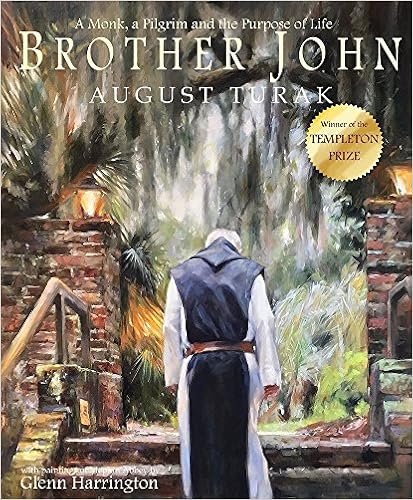
Book Review of Brother John: A journey for meaning
While many contemplative and meaning-focused texts can be quite philosophical and/or self-help-like, Brother John is an excellent example of spiritual story telling. The fact that it's a true story makes it all the more powerful. Turak's story telling is a perfect example of a spiritual biography that can inspire and encourage.
Turak provides spiritual and philosophical reflection and insights without feeling preachy or heavy-handed. He shares his story. He shares his reflections. He shares his conclusions. He offers them to the reader in case they're helpful. I think most people will find them meaningful.
A big differentiator in the text is the addition of paintings throughout the book from Glenn Harrington. Here's a preview from the trailer:
The paintings helped me slow down and engage the book as a journey. I can easily tend towards scanning texts to gain the basic points of knowledge trying to be conveyed. That's the not the point of this book, at least from my perspective. It's meant for us to reflect. Hearing Turak's personal story gave me a sense of peace after reading and motivated me to personally engage in some slower contemplative activities that I tend to put off for achievement-oriented activities.
Overall, this book felt less like reading a book and more like an experience. It's short, so it can easily be read in a single sitting, easily less than 30 minutes. But the insights will stick around longer. And I believe it's a book with visuals that one could easily come back to repeatedly.
I have to note that I also love that Turak has given the rights and proceeds from the book to the Self Knowledge Symposium Foundation (SKSF), a group he founded with his prize to help build meaning and purpose throughout the West, especially in colleges. Buying the book not only provides the reader with spiritual wisdom, but can also financially support others' journeys as well.
Disclosure of Material Connection: I received this book free from the publisher. I was not required to write a positive review. The opinions I have expressed are my own. I am disclosing this in accordance with the Federal Trade Commission’s 16 CFR, Part 255: “Guides Concerning the Use of Endorsements and Testimonials in Advertising.”
This page contains affiliate links. If you make a purchase through this link, we may receive a portion of the sale at no additional cost to you.
Monday, August 22, 2016
What Jobs Are Important?
During each of the fires, including this one, there was an outpouring of well-deserved appreciation for the fire fighters who saved the town. Their tireless efforts continue to impress us.
At the same time, working the public sector and having been involved in two national-headline-making disasters in the past year, I've also seen that there are MANY more people involved in disaster response than fire, police, and medical. There are a variety of departments, professions, and workers who are deployed 24/7 (often without the overtime and other well-deserved benefits of fire, police, and emergency medical personnel). These other individuals tirelessly help people put their lives back together, provide comfort and resources to those who need it, and help navigate bureaucracies. If you've never been in a disaster, these things may seem superfluous, but the aftermath of a disaster can actually be more traumatic than the disaster itself.
In some ways, I think we place importance on professions and work based on Maslow's hierarchy of needs, as those who support the basic things are most critical. Is that really fair or accurate? Frankly, losses in some of the higher levels lead people to suicide, so I wouldn't minimize things beyond basic life needs. Those who support disasters in traditional first responder roles are often recognized because of placing their safety on the line. This is not to be minimized. However, the implication is that psychological safety and other parts of life from other first responders are minimized. Being on call actively 24/7 for months on end to survivors of traumas is dangerous work and changes lives forever. It's quiet work, though, and rarely acknowledged.
So let's generalize this. We have a hierarchy for careers. I went into psychology for the meaning. I do believe it is meaningful, and therefore important, work. But how many jobs do we dismiss as "menial," fundamentally limiting their sense of importance and then the workers' sense of meaning? A classic example is a trash truck driver, a job few people would want. What would happen if this profession disappeared? We'd suddenly consider it important. What about amusement park ride operators or ticket takers? Sure, entertainment isn't important in a traditional view of Maslow's hierarchy. However, what would life be without any entertainment? I think it helps us bring meaning, order, and balance to our lives. And without workers to support these things, our lives would be significantly affected.
So do some people really have more important jobs? If so, what should we base importance on?
Friday, October 12, 2012
Is There Always Meaning?
Monday, April 9, 2012
Protecting an Institution
Tuesday, May 31, 2011
DO Less, BE More @TBBMediaGroup @audrajennings
I've read several books that talk about slowing down, but many are honestly just lame. They talk a lot of theory and make excellent points, but they make it hard to put into practice. John Busacker's new book, Fully Engaged: How to DO Less and BE More, attempts to tackle the issue of overburdened American lives.
Most of the underlying principles he discusses are honestly nothing new; I've heard them many a time and have told my clients and families about them frequently. However, his presentation is different. At the end of each chapter, which are easy reads, he includes some exercises. These are not the cheesy, artificially-created application questions or strained spiritual disciplines that so often appear in contemporary self-help books. Rather, they are non-time-consuming questions, reflections, or actual activities to help the reader self-reflect.
Ultimately, I think this is the strength of Busacker's work and what is often missing in most dialogue about busyness, stillness, and connecting with God. He asks the reader to look in themselves and see what's stopping them from being able to slow down. As a psychologist, I think this is vitally important, as we often try to simply replace one thing with another without exploring why we don't want the replacement in the first place.
At the same time, we do need to replace the maladaptive portions of our lives with something positive. I appreciated how Busacker focused on our values and living congruently from them. Much of the exercises and reflections are oriented in such a way to help the reader explore his or her values.
I tend to pride myself on knowing my values and living from them. But there was something in the way Busacker presented this material (I can't put my finger on it) that hit deeper. While I do think I have a clearer sense of meaning and purpose than many in modern society and live from that purpose to a great extent than a lot of people, I'm still greatly lacking. This is true specifically in my "down time," or more accurately, my inability to let myself have a down time.
The way Busacker reminded me of my values and the priorities of each of them really helped me slow down this weekend. I allowed myself to rest, which is something I greatly needed. Busacker's conceptualization of a fully engaged life, contrasted with "life worth" is particularly helpful. It does not discount the role of work and achievement, but puts them in their proper place:
Leading a fully engaged life begins with a multi-coordinate focus on your life worth—a realization that
Relationships matter more than anything.
Health determines your quality of life.
Work gives voice to your giftedness.
Hobbies engage your energy beyond work.
Learning animates your imagination.
And Faith gives all of your life purpose. (p.36)
Disclosure of Material Connection: I received this book free from the publisher. I was not required to write a positive review. The opinions I have expressed are my own. I am disclosing this in accordance with the Federal Trade Commission’s 16 CFR, Part 255: “Guides Concerning the Use of Endorsements and Testimonials in Advertising.”
Thursday, May 19, 2011
Finding Value, Identity, and Purpose in the Bible @iShineLive @TyndaleHouse @AdamSab
The main selling point of the iShine Bible is that it will help kids discover their value, identity, and purpose in Christ. Those of you who know me well know that those are three things that I value highly in spirituality and psychology. I definitely see those at play not only in tweens' lives, but throughout all generations. In fact, the short devotional essays on each concept was meaningful to me personally (I often struggle with those, especially my own inherent value).
These values are a perfect fit with the Bible. However, they were really separated into their own sections. While the content is definitely congruent with the narrative of the Bible, I would have liked to see more devotional elements sprinkled throughout the text. As it stands, the iShine Bible is mostly a nice tract on value, identity, and purpose in a compact Bible. Not bad, just not remarkable.
The media links are a nice engaging touch that takes the Bible out of an isolated book into a world of engagement, which should be the case. There is also a section written in language appropriate for tweens about various questions tweens may have about theology and life. The answers are clear with good Bible references. However, they are often over-simplified. In working with this age group, I can attest to the fact that they can deal with far more intellectual complexity than we often assume.
Interestingly, it took me a while to find out why it's called iShine. At the bottom of the dedication page, there is the little phrase, "Because I am, I shine." I like it. It's simple and to the point. And it was actually quite meaningful to me. Perhaps the shorter devotionals could be useful for this population. It's not too much to get overburdened by, but enough to make one think. If nothing else, I think the iShine Ministries are off to a good start.
Disclosure of Material Connection: I received this book free from the publisher through the Tyndale House book review bloggers program. I was not required to write a positive review. The opinions I have expressed are my own. I am disclosing this in accordance with the Federal Trade Commission’s 16 CFR, Part 255: “Guides Concerning the Use of Endorsements and Testimonials in Advertising.”
Wednesday, April 27, 2011
The Heart of a Pastor @christianaudio @caReviewers
Peterson's book is a perfect example of how amazing of a writer he is. His prose becomes beautifully poetic (and I'm one who generally dislikes poems) with vivid imagery. In the afterward, a letter to a young pastor, he stated that he does not feel like he is a pastor of great achievement. While he did translate The Message Bible and has written many books, I got the sense from reading this that he is not your typical uber-famous Christian who has met the world's standards of success.
Yes, Peterson has had some of that, but he writes not to be famous, but because that is his love and passion. In fact, his personal testimony about the development of The Message makes me love and appreciate it all the more.
But returning to his pastoral work, this is where he finds his primary identity, with the writing elements being more of a supplement to that work. As a pastor, he led a flock of about 500 by the time he left. That's large compared to many institutions, but quite modest compared to those congregations of the best selling authors. And Peterson seemed to have no problem with the size. In fact, he indicated that he didn't want it bigger. He was satisfied with his work, and it showed through his heart and the true, lasting transformation that occurred in his community.
As a psychologist who definitely can be tempted by trying to achieve widespread notoriety, this tome reminded me of the power of daily, incarnational work that we all do on a daily basis. Our daily relationships and connections are what counts. Peterson knows that and lived it. And I have been blessed by his testimony of that life.
Disclosure of Material Connection: I received this book free from the publisher through the christianaudio.com book review bloggers program. I was not required to write a positive review. The opinions I have expressed are my own. I am disclosing this in accordance with the Federal Trade Commission’s 16 CFR, Part 255: “Guides Concerning the Use of Endorsements and Testimonials in Advertising.”
Tuesday, April 26, 2011
Why I Ask Questions And Don't Give Answers
The biggest question I get is why I ask so many questions, leave them open-ended, and don't give clear stances. A lot of people want the clear, unambiguous answers, particularly related to spirituality. Heck, Wikipedia cites professor Rob Wall as saying Mark Driscoll's authoritative, clear, definitive speech is what makes him so popular. I agree.
This blog isn't for those people. It's also not for people wanting to find out what Christianity is about. It's not for "baby Christians."
My intention is to write a blog for people who have been Christians and have questions. They have doubts. Struggles. My purpose is to provide a space where people can have questions, doubts, struggles, and ambiguity while not having to give up faith.
So often the institutional church creates a perceived and real ultimatum of doctrinal certitude that if you don't believe a certain thing, then you may not be a Christian. I personally believe there is a very small number of issues that really determine a person's salvation. I was talking to a friend just the other day that I have a relationship with God that exists beyond doctrine. Virtually all of my beliefs could be proven to be false, and I would still struggle with giving up my faith because of that relationship.
My faith is based on relationship, not doctrine.
Doctrine, while important, can often lead to impediments in our relationship with God, usually because of man-made wall that our friends construct. While I do believe in walls, I have also found that there comes a time when people have to discover them on their own. Simply being told about the walls and enforcing them doesn't always help growth. Helping people explore and understand and discover the boundaries and mysteries of life and faith is much more powerful.
So even when I do make a more definitive statement or take a position, I also usually attach questions to it. My goal is to get people to think and think critically about themselves and their faith.
I do the same thing in my psychology practice. Many people come in looking for advice. They generally don't get advice from me. I help them come up with the advice they give themselves.
So why do I ask questions? Because millions of people ask the same ones and need a forum to know that they're not alone and can still pursue God in the midst of those questions. Why don't I provide clear answers? Because I don't find that effective for the population I'm aiming at.
You may be one who wants clear answers. If questions or ambiguity hurt your faith, I don't recommend you continue to visit. I have found ambiguity pervades all of life, especially mine. The more I can come to accept and be comfortable with the ambiguity rather than forcing on an artificial answer, the closer to God I get. And that's my hope for those who read this blog.
Friday, September 24, 2010
Don't Waste Your Life @JohnPiper @christianaudio @caReviewers
Another of Piper's books became available in christianaudio's reviewers program (with a complimentary copy), so I decided to take the opportunity to give Piper another chance. Don't Waste Your Life is actually an older book of Piper's (from 2006), and it definitely gave me a more positive view of Piper.
I'm still not a Piper fan, but he presented a much more balanced view of life in this book. As the title suggests, he is encouraging people to not waste their lives. In short, we need to live for Christ and not for the materialism of the world in order to not waste our lives. He gives an excellent story from his childhood that his father would frequently tell people about an older man who died feeling like his life was wasted on "worldly" endeavors.
I agree with this viewpoint. We need meaning and purpose in life, and the only way to get true meaning is by loving others through Christ (or more accurately, letting Christ love others through us). I also appreciated that Piper acknowledged the various ways people can enhance the Kingdom--not always through explicit ministry. He did an excellent job of supporting an incarnational view of spreading the Gospel, as he noted the critical need of people to do "mundane, secular" jobs.
He illustrates these points with nice stories, anecdotes, and metaphors. At the same time, it would have probably been easy to make a more concise version of the book.
In his eagerness to emphasize the tragedy of a wasted life, Piper also invalidates other life tragedies. He explicitly states that people getting cancer and dying in accidents are not tragedies. I greatly and passionately disagree. These are all tragedies; just different types.
Further, there was still too much emphasis on sin and leading a holy (meaning morally pure) life. From my post Wednesday: "While we do need to combat sin and move toward moral purity, this is something that is impossible in this world. And it's not the primary goal of the Gospel or what God wants, in my opinion. He wants a relationship with us. And battling sin can get in the way of that. If we are always beating ourselves up in order to repent, we are ignoring God's redemption and therefore ignoring God."
Different Christian traditions emphasize the roles of repentance and redemption to varying degrees. Piper clearly comes from one that sees the role of continual repentance as central. I think we need to emphasize redemption more.
Monday, May 31, 2010
Caring for Your Heart @ransomedheart
![]() | |||
![]() | |||
Wednesday, May 26, 2010 Do Whatever Brings You Back to Your Heart and the Heart of GodAgainst the flesh, the traitor within, a warrior uses discipline. We have a two-dimensional version of this now, which we call a "quiet time." But most men have a hard time sustaining any sort of devotional life because it has no vital connection to recovering and protecting their strength; it feels about as important as flossing. But if you saw your life as a great battle and you knewyou needed time with God for your very survival, you would do it. Maybe not perfectly-nobody ever does and that's not the point anyway-but you would have a reason to seek him. We give a halfhearted attempt at the spiritual disciplines when the only reason we have is that we "ought" to. But we'll find a way to make it work when we are convinced we're history if we don't. | |||
| |||
|
Wednesday, March 10, 2010
66 Love Letters Lenten Devotions
Friday, January 29, 2010
Purpose of Church
I hadn't thought of it in terms like this, but I realized I do not feel like I really need church to connect with God, per se. I feel like I connect with God very well on my own and with my wife. I do not need a church to do that. This particularly true with contemplative techniques. For me, they feel more effective in solitude or with a small group than with a large group.
In contrast, church seems, for me, to be an opportunity to connect with other believers and experience God incarnationally. Now, this is therefore a way of connecting with God, but it is a slight difference from directly connecting with God.
The relationships among the Church body are important. They give us life and help us remember our priorities.
Church organizations are not necessarily needed to connect with God, I don't believe. That is not to say church and Church (the former being the organization and the latter being all believers) is not important. To the contrary: It is quite important, but not necessarily for the reasons we often are told about church.
This is definitely a distinctly Protestant view, of course. What do you think?
Wednesday, January 13, 2010
Just Don't Read Just Do Something
I was looking forward to this book, expecting a bit of an incarnational perspective on finding God's will. That was there, but not in the way I expected. It presented nothing useful and was possibly the worst religion book I've read (or listened to). In fact, I think it can be quite spiritually, relationally, and psychologically damaging.
It seems appropriate to start the review with the title. Compared with other books I've reviewed recently, this title is very appropriate and accurate. In fact, it tells you exactly what the book is about. DeYoung's answer to God's will is don't worry about it; just do something. Anything. As long as it is not morally reprehensible.
This is where I started having problems. DeYoung discusses valid problems in today's society, namely indecision. But his solution is too extreme of just doing something. I do not believe that is the answer, nor is it God's desire for us to just act. I could probably go line-by-line with counterpoints to DeYoung's assertions, but that would make another book, and it's hard to do with an audiobook.
Here's a couple of his main points, though. One is that we do not really need to seek counsel in most any situation. That's what God gave us a brain for. Okay, that's true that we should use our minds, but that's also what the Holy Spirit is for. DeYoung's way of dealing with God's will does not require any real relationship with God; it just requires a knowledge of Scripture. He states that the Spirit speaks to us through Scripture. Fair enough. But he also speaks to us in other ways. True, they're subjective at times, as DeYoung says, but that does not mean they're unhelpful. Frankly, biblical interpretations are subjective, too.
He argues decisions need to be made in alignment with God's goals for our lives. I couldn't find the quote again in the audiobook, but the first two goals are moral purity and theological fidelity. Compassion was in the list, but it almost seemed an afterthought. While moral purity and theological fidelity are nice, Jesus did say the greatest commandment is to love God and love others. I think love is the primary purpose.
DeYoung argues that we do not have to worry about what we do because whatever we do will be what God's will is. Sorry. Completely disagree there. There's many examples everyone could come up with of ways that we act that are not in alignment with God's will.
He also asserts that we should never worry because that is a sign of little or no faith. True, God does not want us to worry, but we do. That's normal and not necessarily a sign of spiritual frailty. I could go on on this topic for hours from my psychology profession...
Then there's the real juicy stuff. It seems one of the primary reasons he wrote this book is because people are waiting to get married. He stated that in most cases, people should be married and own a house by 30. He sees a lot of problems as due to delayed marriage. That may contribute to some social problems, but there may be other, better solutions than just getting married earlier.
He almost argues that everything will be solved by marriage and mentions many "problems" due to and causing delayed marriage. Frankly, many of them seem like no big deal and not problematic. While he states there is nothing wrong with singleness, I just simply do not believe him. He pushes people to get married, saying things like, "Getting married is good for your sanctification."
He tells men that if you like a girl (and she likes you), you're both Christian, and no one has major problems, get married. This is one of the worst pieces of advice I've ever heard. This is the kind of thing that causes needless divorce or horrific marriages.
He goes on to say that women start a career, "which is not necessarily wrong, when they would rather be married and having children." He says, "Men, if you want to be married, find a godly gal, treat her right, talk to her parents, pop the question, tie the knot, and start making babies." I couldn't even believe I heard him say these things.
Not that these aren't important, but marriage and kids don't have to happen immediately. And they definitely do not solve all problems. There's also a lot more to life than that. DeYoung does not think so, arguing that fulfillment is selfish and not in God's plan. He needs to read the psychological literature on it, though, starting with Maslow's hierarchy of needs. In a situation, like many of my generation's grandparents grew up in, the focus was on a lower level of needs (like food and shelter), which were not guaranteed. Now for most Americans, those are not a struggle, so we can address higher level needs, including self-esteem and self-actualization. They are critically important.
My wife listened to this section, and she was shocked, also saying this book is awful, damaging, and offensive to women. She adds, "this is exactly the kind of crippling fear that so many single women feel today... that there's something wrong with them because they're not married yet.. this just adds to that feeling of inadequacy! The author is basically saying that we as women are all just waiting around for a man to come along so our lives can finally start. That's sickening." I completely agree.
DeYoung relies too much on his grandfather's perspectives as fact. We need to look to our elders for wisdom, but not all of them did things perfectly nor do they understand everything perfectly. My grandpa would disagree with his. So does that mean I can write a book arrogantly asserting that I know all Truth about God's will based on my grandpa?
The narrator, Adam Verner, was fine. He had good tone and intonation and made the book relatively interesting. Frankly, he was the best part of the book.
Better books dealing with God's will are John Eldredge's Walking with God (DeYoung criticized an unnamed book, but I think it was this one) and Francis Chan's Forgotten God. If you want a contrary opinion to those books or want to explore perspectives on God's will, this could be useful. Otherwise, don't waste your time on this book. I think it's unhelpful at best, spiritually and psychologically damaging at neutral, and possibly borderline heretical at worst.
Friday, October 2, 2009
Tradition
I saw Fiddler on the Roof at the Orange County Performing Arts Center a few weeks ago. One of the classic songs is called Tradition, and as Tevye says, he doesn't know why they do a lot of what they do. It's just tradition.
As most of my close friends know, I am not a fan of tradition, particularly tradition for tradition's sake. I think actions need to be meaningful. Traditions can be very meaningful when you understand why they are there and when they still have relevant meaning. Yet so often in life (related to spirituality and not), we take actions simply based on tradition. And I think that is the cause of a lot of problems and crises in faith eventually.
What do you think? Is there value in tradition for tradition's sake. When is tradition useful/good?
Tuesday, April 7, 2009
Fathered by God Event
Fathered By God Tour 2009 | |
![]() | An Evening for Men and the Women Who Love Them |
| Saturday, April 18, 2009 Evangel Temple | 5350 Veterans Pkwy Columbus, GA 31904 | |||
| Sunday, April 19, 2009 Stonecreek Church | 13540 Highway 9 North Milton, GA 30004 | |||
| Monday, April 20, 2009 Southbrook Church | 5607 Weddington Monroe Rd Weddington, NC 28104 | |||
| Tuesday, April 21, 2009 Immanuel Bible Church | 6911 Braddock Rd Springfield, VA 22151 | |||
| Wednesday, April 22, 2009 Christ Community Church | 1215 Hillsboro Rd Franklin, TN 37069 | |||
| Friday, May 8, 2009 Fellowship Bible | 9330 N Central Expwy Dallas, TX 75231 | |||
| Saturday, May 9, 2009 Hope In The City | 4407 Monterey Oaks Blvd Austin, TX 78749 | |||
| Sunday, May 10, 2009 RiverChurch (WorldView Comm. Church) | 6941 Columbia Rd Olmstead Falls, OH 44138 | |||
| Monday, May 11, 2009 Kensington Community Church | 1825 East Square Lake Rd Troy, MI 48085 | |||
| Tuesday, May 12, 2009 Church of the Open Door | 9060 Zanzibar Ln Maple Grove, MN 55311 | |||
| Saturday, May 16, 2009 Grace Chapel | 9600 SW Boeckman Rd Wilsonville, OR | |||
| Sunday, May 17, 2009 Eastside Foursquare Church | 14520 100th Ave Bothell, WA 98041 | |||
| Monday, May 18, 2009 Calvary Bible Church | 18621 N Highway 99 Acampo , CA 95220 | |||
| Tuesday, May 19, 2009 Mariners Church | 5001 Newport Coast Drive Irvine, CA 92612 | |||
| Wednesday, May 20, 2009 Central Christian Church Of the East Valley | 933 N Lindsay Rd Mesa, AZ 85213 |
Friday, August 8, 2008
Attack on Joy
On the heels of yesterday's post, I'm feeling a bit of an attack on any joy I may have. Actually, while writing this, I'm realizing how much of a directed attack it seems. One of the core points of Ransomed Heart and John Eldredge's works is that there is spiritual warfare that aims directly at our hearts. I must admit that I have struggled with the idea of a conscious, intentional evil at work, but Eldredge's comments matched with experiences such as this make for some interesting considerations, to say the least.
Yesterday, I talked about two things specifically that have brought me true joy: my wife and my clients. Last night, I had a dream that Laci died in an atomic bomb attack. I survived somehow. Pretty unrealistic dream, I know, but it has still affected me throughout the morning.
Then I was faced with comparing myself with others. Again. I tend to do that often. I always feel like I have to do more. I have to make the spiritual insights that will change millions of lives. Only then will I be worthy. Having only one or two degrees of minor separation from some people who are well-known and influential, I often question my own path. Am I doing enough? They're so much more important than me.
A few minutes ago, though, I remembered another revelation that hit me a couple of months ago. If you've been reading this a while, you'll know my first professional publication was finally published. Particularly for where I am in my career, this is a big deal. Many people may read it. It's my opportunity to share great wisdom with the masses (yes, I'm being a bit facescious, but the point stands). I should be flying high. Yet I wasn't. I got a nice thrill when I opened the mail with the book in it. It was fun bragging to family and friends, and I got many pats on the back and congratulations. But it faded fast. Real fast.
Then I compare a client I terminated with about the same time. By the end of our very short number of sessions, she was crying that our time was over and that she was so grateful to me because for the first time in her life, she believed in herself, which was more important than her graduation. That was the hardest termination I've had to date. And that conversation has stuck with me for months now. It is for those reasons that I do what I do. It is those conversations that keep those of us in the psychological field going. This is my calling.
The problem is I forget. We all often forget things like this. We get side-tracked. Our focus gets changed. We believe other things are more important. We lose sight of our humanity and the humanity around us. And then we die. As Eldredge has said, that's the goal of the Accuser.
I doubt this struggle is over for me. I don't feel fully resolved from this particular instance, anyway. However, I will try to remember. God showed me today that He will come in and remind me, too. I just have to be open to being reminded. And I think we should have ways of reminding ourselves often. Interesting how finding ways of remembering is such a central motif throughout the Bible...
Monday, June 30, 2008
Professional v. Perfect
There is a certain amount of quality that goes along with professionalism, and that varies by industry. I think professionalism relates more to using resources wisely and to the best of people's abilities. Too much focus on perfection, though, makes us forget about our true purposes. I see that happen a lot. I'd rather forgo perfection, even professionalism, to maintain a clear sense of purpose, meaning, and good intentions in what I do.
Related to the Church, Sunday morning gatherings should be focused more on connecting with people and providing ministry than putting on a good show. This isn't anything new; many people have said it. However, many people also say they agree with this statement, but continue focusing on superficiality in the name of professionalism. Professionalism while sacrificing ministry is not worth it. Thoughts?
Saturday, June 28, 2008
Maintaining Connections
While I have actually not be a fan of the social networking websites, I just started trying out a couple of more... because of my nerdiness. Yes, that's right. I was looking at different web browsers and came across Flock, which is based on Firefox, but has a lot of neat features built in, including blogging functions and social networking. It helps bring everything to you. Since I could use new fun technology features, I thought I would try some of it, and I realizing that it can be a very nice way to stay connected to people.
One of my struggles with social networking and forums before is that you have to constantly go somewhere else to check it, whether or not it's updated. It seems like a waste of time and energy. But with this new browser, the info comes to you, like email, and I like that. I've also started getting into the RSS realm, and it has really helped me stay in touch with people, news, and commentary. As I talk about conversation being important here, I recommend these tools as ways to keep up-to-date and involved in the conversation, particularly when things like Flock make it easy to do that!
I also constantly maintain that relationships are the primary purpose in our lives and the means for spiritual formation, so I guess I have little reason to keep resisting these formats just because of their popularity (why do we do that sometimes?). In fact, they can help our spiritual formation and keep us focused on our purpose in our lives. Just like Rich Samuels said in one of his comments to me about business, these social networking technologies can also help us keep focused on the higher goal of technology--to keep us connected and in relationship rather than just efficiency and productivity.
Tuesday, June 24, 2008
The Purpose of Blogging
I thought the purpose of a blog was to make a major difference in the world. But is that really the purpose? I saw a t-shirt on a website recently that said, "More people have read this shirt than your blog." I laughed out loud when I read that. And believe it or not, I didn't really care that that was true in my case. I don't know if anyone reads this.
Which gets to my question of what is the purpose of blogging, at least for me. My goal here has been to get people to think and get into dialogue about difficult topics. That doesn't mean I have to have the answers or even insightful comments. That just puts performance pressure on me.
That's one of my biggest struggles: Performance and perfectionism. I read this interview with the director of WALL•E, in which he discusses how with Toy Story, they attempted to please the Disney execs. And the project was almost cancelled. The Pixar people then went back and made the movie they wanted. The result was the smash success we all know.
It's amazing what happens when we listen to hearts versus our heads of what to do next. Whenever I have caught myself in this struggle and moved toward listening more to my heart, I've been told I make much more of an impact on people.
So that's my goal here. I'm going to try to stop performing and just post whatever is on my mind and heart, even if it's not in a well-thought-out series of brilliant insights. Maybe it'll get someone to think. And if no one else reads it, at least it's helped me to think and process my own thoughts and struggles...
As an adjunct to this, I've included a new box on my blog that has other articles and blog that I have "shared." I may comment, I may not, but they're things that I think are interesting, often to get people to think. And feel. I hope... :)


