Sunday, October 18, 2020

How should Christians vote? A new book provides many perspectives in a complex 2020.

Every election season, there is substantial discussion of how people of faith (really, any faith, but in the US especially, Protestant Christian faith) should and do vote. 2020 has particular attention on this area since the white evangelical community hugely supports Donald Trump, while others argue that Trump displays and supports zero Christian values. How do we approach these various views?

One consistent perspective is that Trump's style, personality, and character leave a lot to be desired. A classic evangelical line is, "it's about policy, not personality, so we can ignore how someone behaves if they support our perspective."

Does that approach align with biblical values? Many people are struggling with that. Further, many people have family members, friends, and co-workers who all report coming from the same faith background yet come to very different political stances. I have experienced this first-hand and frequently wonder how so many of us can see things so dramatically differently.

Recently, a new book, Keeping the Faith, was published, addressing a range of perspectives on Christian faith in relationship to Donald Trump. One of my long-time friends, Jesse Wheeler, is a contributor and raised my awareness of this text. There are many contributors who I'm aware of and respect.

To be direct, the contributors of this book all take the stance that supporting Donald Trump for President of the United States is contrary to the Christian faith. Therefore, some people may automatically love it or hate it. For Never Trumpers, this book can reinforce their perspective. For MAGA-ites, this can represent people who have strayed from the faith.

I think the best way to approach this book is to be open to understanding broad perspectives and move us toward more unity in love. While votes and perspectives may change due to this book, (and I personally hope people gain self-reflection and wisdom from it,) a more realistic goal is to help us really listen to each other more.

One of the key unique attributes is that the contributors come from a wide range of perspectives: politically, theologically, geographically, demographically.

Even for those who agree with the fundamental premise of voting Trump out could benefit from better understanding how our political system impacts people who are different from them. There's immense value in that. Plus it's highly biblical and in alignment with the Greatest Commandment. The range of content and perspectives, including authentic attempts to really listen to and understand the Trump supporters, can help the anti-Trump crowd to better understand the needs, desires, and especially fears of their Trump supporting brothers and sisters. I know there is a lot of confusion and pain in this community trying to comprehend why some Christians would support Trump. This book may assist with that.

For those who have or will vote for Trump and want to understand why many Christians do not agree, this can be a powerful text to help raise awareness of the range of reasons for the stance. Again, it would be easy to approach this book with automatic criticism and dismissal. I encourage folks in this camp to listen honestly and openly to people who represent family, friends, and literal neighbors. We need this kind of listening. Your opinion doesn't even have to change, but hopefully some empathy will build. Similar to the anti-Trump group, there is a lot of confusion and pain in the pro-Trump group about those who do not support his Presidency. Listening with an open heart may assist with compassion and reconciliation.

Finally, this book can be quite useful to the group who does not know what to do. I think the authors are really hoping to touch this audience. As shared in many of the stories, it's hard to disagree politically with people in church institutions. Many of us have been taught there is only one right way to vote if you are a Christian. This book gives an alternative view, providing honest feedback about how one can be authentically and deeply Christian and not vote for Trump.

To this point, I really appreciate the wide range of content presented, as well as the book's organization. There may only be one or two areas of concern that someone wants to dive into more deeply (e.g., abortion, immigration, foreign policy, etc.). There are sections with multiple essays from differing perspectives and backgrounds on critical policy topics, all from Christian perspectives.

Further, I loved how the whole book began from a perspective on the process of discernment, voting, and dialogue. Rather than jumping straight into complex content, the authors started with the importance of context, immediacy, and political discourse. The reasons for having this discussion and how we could engage with the content lays a wonderfully biblical foundation focused on a core principle we should agree on: Unity in Christ.

We are not all going to agree on political outcomes, candidates, and policies. However, Keeping the Face helps change the narrative for the American Christian community. It provides a modern prophetic voice to keep us honest to listen to all of our compatriots, not just focusing on own personal rights, needs, fears, and hopes. A core part of the Gospel is that it's Good News for all. Our voting should align with that.

Disclosure of Material Connection: I received this book free from the publisher. I was not required to write a positive review. The opinions I have expressed are my own. I am disclosing this in accordance with the Federal Trade Commission’s 16 CFR, Part 255: “Guides Concerning the Use of Endorsements and Testimonials in Advertising.”

Sunday, December 16, 2018

A Card Deck for Centeredness (Product Review)

Mindfulness, strengths-based work, contemplation, and similar wellness-oriented activities, especially with overlap in psychology, are major areas of interest for me. I also tend to be drawn to prayer card decks.

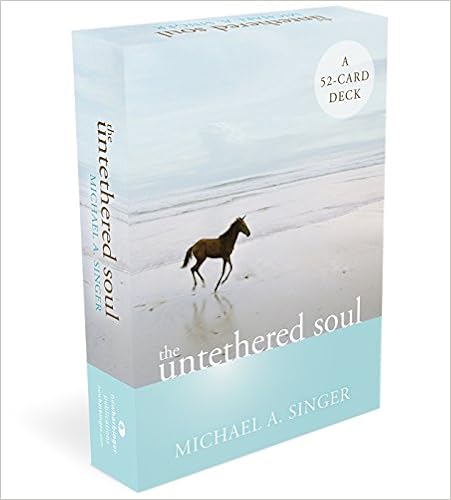
The Untethered Soul card deck from Michael A. Singer, based on his book of the same name, caught my attention as perhaps a more secular version of this interest. These 52 cards have short phrases to inspire and help center readers.

First off, the box and cards are very well made and beautiful in their own right. It doesn't feel like a cheap paper or cardboard container or deck set. It's something that looks nice on a desk, which is exactly how I use this one. I put the lid on the base at a 90 degree angle, providing a background and display a different card each week.

The image backgrounds have a good nature basis that can be used for contemplation and almost automatically provides some relaxation. The phrases, grouped into themes, can be encouragements, inspiration, or even questions encouraging reflection. One could easily just read through all the cards and move on with life, but that would miss the point. Sitting with them for contemplation and centering work is where they're useful.

As I suspected, they do have a more secular feel in many cases. However, some cards draw from various religious traditions, albeit lightly. If someone wants encouragement from a single tradition, you'll probably want to pass on this set. However, if you're open to considering wisdom from around the world, the phrases and considerations can be a useful foundation for contemplation and meditation.

The deck's trailer provides a bit more context:


This video makes the deck seem quite new age-y/self-help-like, and it can have that feel (positively or negatively, depending on your perspective). However, I have to say I think the promises in the video are more than a bit over-stated. No card deck or phrase will be truly transformative on its own. If you view the deck as an opportunity to remind yourself to be present and reflect, then it can be useful. But the sayings aren't necessarily any more inspirational or transformative than other decks. In fact, the lack of a firm spiritual tradition or psychological rootedness may make the deck and phrases appear to have less depth or "thickness."

In any case, this can be a nice gift for a loved one or even yourself. The benefit of it not being overtly spiritual is it can be used as a gift in many contexts.

Disclosure of Material Connection: I received this card deck free from the publisher. I was not required to write a positive review. The opinions I have expressed are my own. I am disclosing this in accordance with the Federal Trade Commission’s 16 CFR, Part 255: “Guides Concerning the Use of Endorsements and Testimonials in Advertising.”
This page contains affiliate links. If you make a purchase through this link, we may receive a portion of the sale at no additional cost to you.

Saturday, December 15, 2018

12 Practical Celtic Spiritual Activities (Book Review)

The Celtic traditions have long held deep meaning for me. There's something about the Incarnational and holistic approach that makes it theologically and practically impactful and relevant in my mind. I have been a reader of Christine Valters Paintner's devotionals and work for a few years now, and love her spirit and wisdom.

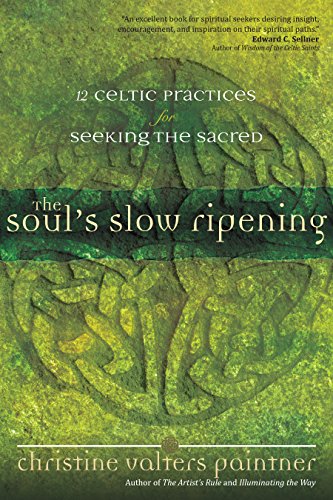
All of this made me interested in her newly released book, The Soul's Slow Ripening: 12 Celtic Practices for Seeking the Sacred. What is unique about Paintner's approach is that she provides a personal spiritual story, some historical background, biblical reflections, and concrete spiritual formation-type activities, including lectio divina and even photography, to help bring these practices home.

I also appreciate that her husband, John, regularly contributes to the reflections and applications of the practices. Another voice and perspective, albeit aligned nicely, bring additional context and wisdom to the text.

Paintner explicitly states that this book can be read from front to back, but also can be digested in any order desired. It really is that flexible, allowing the reader to dive into whatever practice is most relevant at a given moment. The subheadings and different aspects presented to each practice not only make them more concrete and readily applicable, but also provide easy moments to pause in readings and pick back up.

This isn't necessarily a book that one would read once through for lessons, although it could be used that way. Rather, it could be more of a reference tool, being picked up at different phases of life for wisdom and spiritual suggestions. There's enough variety and diversity that I can see it being useful in many contexts and phases of life.

It has enough philosophy and theology that it can have meaningful depth for those desiring traditional substance. It also has excellent practicality that it doesn't feel too "spiritual," abstract, or philosophical. The Paintners both come across as very practical to me, striking an excellent balance between Heaven and Earth.

If you're interested in Celtic traditions, this is an excellent addition, either for early explorers or even those seasoned in Celtic Christianity and spiritual formation.

Disclosure of Material Connection: I received this book free from the publisher. I was not required to write a positive review. The opinions I have expressed are my own. I am disclosing this in accordance with the Federal Trade Commission’s 16 CFR, Part 255: “Guides Concerning the Use of Endorsements and Testimonials in Advertising.”
This page contains affiliate links. If you make a purchase through this link, we may receive a portion of the sale at no additional cost to you.

Friday, December 14, 2018

Book Review of Brother John: A journey for meaning

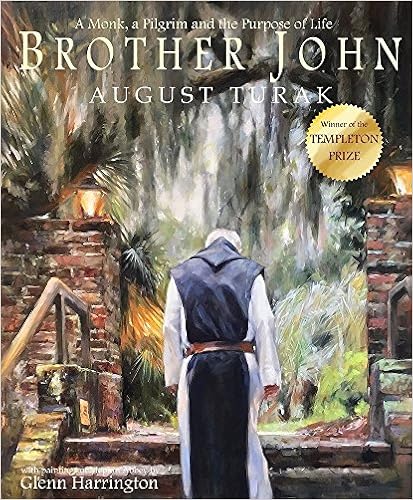
A book as a contemplative spiritual experience. That would be my summary of August Turak's Brother John, a formally published and beautifully illustrated version of an essay for which he was awarded a Templeton Prize.

While many contemplative and meaning-focused texts can be quite philosophical and/or self-help-like, Brother John is an excellent example of spiritual story telling. The fact that it's a true story makes it all the more powerful. Turak's story telling is a perfect example of a spiritual biography that can inspire and encourage.

Turak provides spiritual and philosophical reflection and insights without feeling preachy or heavy-handed. He shares his story. He shares his reflections. He shares his conclusions. He offers them to the reader in case they're helpful. I think most people will find them meaningful.

A big differentiator in the text is the addition of paintings throughout the book from Glenn Harrington. Here's a preview from the trailer:


The paintings helped me slow down and engage the book as a journey. I can easily tend towards scanning texts to gain the basic points of knowledge trying to be conveyed. That's the not the point of this book, at least from my perspective. It's meant for us to reflect. Hearing Turak's personal story gave me a sense of peace after reading and motivated me to personally engage in some slower contemplative activities that I tend to put off for achievement-oriented activities.

Overall, this book felt less like reading a book and more like an experience. It's short, so it can easily be read in a single sitting, easily less than 30 minutes. But the insights will stick around longer. And I believe it's a book with visuals that one could easily come back to repeatedly.

I have to note that I also love that Turak has given the rights and proceeds from the book to the Self Knowledge Symposium Foundation (SKSF), a group he founded with his prize to help build meaning and purpose throughout the West, especially in colleges. Buying the book not only provides the reader with spiritual wisdom, but can also financially support others' journeys as well.

Disclosure of Material Connection: I received this book free from the publisher. I was not required to write a positive review. The opinions I have expressed are my own. I am disclosing this in accordance with the Federal Trade Commission’s 16 CFR, Part 255: “Guides Concerning the Use of Endorsements and Testimonials in Advertising.”
This page contains affiliate links. If you make a purchase through this link, we may receive a portion of the sale at no additional cost to you.

Monday, February 12, 2018

Review: The Spirit of Simplicity

This review first appeared on the Englewood Review of Books.

The Spirit of Simplicity has a compelling backstory: a 70 year old hidden text written by a famed French Cistercian, Jean-Baptiste Chautard, translated with notes by Trappist (a Cistercian branch) monk, Thomas Merton. In a world of complexity and loudness, simplicity for our lives and souls is compelling and increasingly popular.

The text itself is short: 114 pages of content, including 14 illustrations of monasteries, and 23 pages of notes from Merton. It is broken into two parts: The first being the aforementioned translation of Chautard’s The Spirit of Simplicity and the second excerpts from writings and speeches of St. Bernard of Clairvaux, a leader of the Cistercian order, on the topic of interior simplicity, with added commentary by Merton. From a readability standpoint, the reader must remember this text’s place in history: Part 1 was written in 1920s French, translated into 1940s English, both with a target audience of the theologically trained monastic community. Bernard died in 1153. For readers familiar with dense mystical and theological texts, this time will seem familiar and accessible. For those looking for a simplicity self-help book, it will be a grind.

These kind of expectations is where the key focus of satisfaction with the book will be. This book may be most valuable as an insight into the history of the Cistercian order and its accompanying theological values. Its applicability to a lot of modern Christian life is limited, and many will disagree with many of the principles underlying some of the specific applications of simplicity.

A definition of simplicity may be helpful in assessing the book. In his foreword, Merton states, “simplicity may be defined as a constant and unchanging desire for one object and him alone… In the strict sense, simplicity is the perfect conversion of the will to God, asking one thing of God, and desiring that alone, and not going forth and multiplying itself in the world” (p. xviii). This is a laudable definition, albeit ironically complicated to explain simplicity, emphasizing what a difficult concept it is, especially in practice.

Repeatedly through all sections, the writers emphasize that simplicity is intended to bring union with God and the love of God. This may not be intuitive to many people, especially when exploring intellectual simplicity, a section in Part 2. In fact, Merton explicitly states that our intellect is to help us love: “Hence, simplicity in the intellectual order means subordinating all our knowledge to the LOVE OF GOD. We study in order to love” (85). What if we always thought of the principle of study and academia as helping us love?

This quote also reflects the reason for the process of simplicity: Subordination to God. Humility is the term often used to refer to this process, but it does not refer to general humility. Rather, it is humbling (subordinating) ourselves before God. Simplicity helps us to see God as supreme and sufficient, while helping us be obedient to God’s will. This is easier when not distracted by many things of life.

This moves us to what can be considered the limitations of this book: They are focused on a monastic life, which 1) not everyone lives and 2) not everyone agrees is theologically appropriate.

First to 1: This text was written to Cistercian monks. In Part 1, Chautard notes, “It is therefore a matter of obligation for us Cistercians to return often to the study of our ancient Rule, so that we may never forget the fundamental spirit of our reform to which the Church thought it not amiss to grant the title of a true religious order” (p. 12). This seems to provide the intent of his text. The entire focus is reminding his monastic brothers of their proper behaviors, calling them back to the core intent. Merton’s annotations and additions of Bernard’s writings fall into this same focus. If the reader is not a Cistercian monks, the directions will have limited utility, as they are often very behavioral in the context of Cistercian monasticism.

This brand of monasticism advocates for virtually complete withdrawal from society and people gets to point 2 (whether such withdrawal is really intended). To be fair to this spiritual tradition, it is wise to listen to those who promote it to truly understand the goal. The intent is quite holy, seeing to be more like Christ: “The soul of the monk is to reproduce the inner life of his master [Christ] by observing this Rule. That is all” (21). Indeed, all Christians should seek to reproduce the inner life of Christ. The Cistercian model advocates that the best way to do this is through both internally and external simplicity, stripping away as much as is possible. Chautard explains this by stating, “The monk detaches himself from everything that might weigh him down and bind him to the earth. He wants to be simple, not mixed up with the things that are below him” (9). It is hard to argue with this logic in many ways, as life can be distracting. Merton phrases it differently, but again points to separateness from the world as the way to find God: “The whole aim of the Cistercian life—and the fathers of the order are unanimous on this point—is to set men apart from the world that their souls may be purified and led step by step to perfect union with God by the recovery of our lost likeness to him” (71).

Likely all contemplative models and even most general spiritual development perspectives advocate for times of alone. Looking to Christ’s behavior, such as in the Garden of Gethsemane, reinforce this. Indeed, contemplation and slowing facilitates the mystical experiences that the writers are honorably pursuing. However, this monastic approach advocates for this isolation full-time. Many would argue that this is contrary to Christ’s intent, especially when looking at the Great Commission. A balance of the extreme Cistercian version of simplicity with engagement in the world seems a more accurate reflection of Christlikeness.

For readers who want to better understand some spiritual perspectives, especially in the flow of the history of Western Christianity, this is a useful book. If you’re looking for spiritual guidance and inspiration around simplicity, another book in the spiritual formation genre or on contemplation would be more helpful.

Monday, July 31, 2017

Review: Developing the Bible and Faith Through Story

This review first appeared on the Englewood Review of Books.

Books on the Bible are a dime a dozen, with some worth even less than that. Much ink has been spilled on the nature of the Bible and interpretations of various passages. Often, these books are either overly academic, unrelatable to many readers, or intellectually unsupported.

Rob Bell's latest text, What is the Bible?, is none of these things. In his book, Bell tackles a variety of Scripture passages in order to better help us understand the fundamental nature of the modern Christian Bible. In short, Bell actually answers his book's titular question with its subtitle: How an Ancient Library of Poems, Letters, and Stories Can Transform the Way You Think and Feel About Everything. The Bible is intended to transform our thoughts, beliefs, feelings, and actions through a variety of narrative methods in order to better respond to the world we live in.

In typical Bell style, What is the Bible? is broken up into highly readable and digestable chapters clustered into multiple parts that form an overarching narrative. Initially, the first few chapters were interesting and thought provoking regarding the specific passages being interpreted. However, they seemed disconnected from a larger coherent thesis. It takes most of Part 1 for Bell to really start making his core argument.

At first this approach was annoying and off-putting. The book seemed more helpful as an encyclopedia-type resource that could be helpful in interpreting particular Scriptures. This is not a bad thing in itself, but not exactly how the book seems to be advertised. However, as the pieces came more clearly together, the final effect was far more powerful than a traditional exposition on the nature of the Bible. Interestingly, this approach somewhat mirrors the way Scripture powerfully shares the transformative power of Yahweh and the Gospel--individual stories that don't always seem to connect, but still tell a deeper, developing tale.

Growth and development is really core to Bell's understanding of the Bible. Central to his interpretations of passages are the iterative steps needed to help humans move to new levels of understanding themselves, their neighbors, and the world. This hermeneutic provides compassion for people and situations that are otherwise easy to judge. Building compassion is one of the core traits that God is trying to build in people, so having compassion for our spiritual ancestors is a good place to start. However, a developmental approach to the Bible seems to consistently not be easy for humanity. We tend to take more of a stagnant approach to understanding all things spiritual, trying to make the case for a single perspective and set of laws that are good for all people of all ages in all places in all times. We don't do this with any other part of human development, recognizing the many variables that impact our development (or lack thereof). And when we recognize development has been limited, we can often acknowledge the contextual factors, giving us a chance to better understand where someone is coming from and have compassion on them.

Development, growth, and change, both as individuals and a species, are normal for all parts of humanity. Remembering that this applies to our spiritual lives can be transformative in how we see ourselves, others, and the Bible. Bell actually ends the entire book (even after the traditional Endnotes) with a section entitled A Note on Growing and Changing. He emphasizes this central role of growth and change, providing encouragement to those who may have experienced development, but whose communities may be uncomfortable with the change. Part of this encouragement also builds compassion for ourselves and what was helpful before, recognizing that what was useful at one point in our lives may not be now. This approach might help us better integrate our many lifetime spiritual influences.

This developmental view is similar to Peter Enns' perspective presented in The Bible Tells Me So. Both men use helpful subtitles to clarify their purposes. Enns' is Why Defending Scripture Has Made Us Unable to Read It. Enns is really more focused on helping us be more open to reading the Bible as it is. He includes a bit more scholarship related to biblical interpretation, as this is the core of his text (plus it's more of his background). Bell, on the other hand, is a storyteller at his core, and his theme is more helping us better understand ourselves and our world. Both authors use some similar language to talk about the Bible, and they have similar, accessible, digestable writing styles. These two books could be good as complementary texts, and do not necessarily duplicate efforts.

As noted, Bell is a storyteller. He is famous for his engaging, thoughtful, and moving oration and writing, and this book is no different. His style and approach is consistent with his past work, so readers who like his style will not be disappointed. He effectively brings biblical passages to life in a way few others can. It also works very well in this book, as his writing approach creates an accessibility and relationality that reduces defensiveness, creates intrigue, and invites questions. This is exactly what Bell wants in this book: He wants readers of the Bible to ask questions. Lots of questions. And some of his final chapters are focused on helping people ask good questions.

Bell's book is titled with a question, but he doesn't directly answer the question. In fact, it's a question that is likely unanswerable in a concise, direct approach. A book entitled What is the Bible? seems to be one that would have a lot of direct exposition to provide great clarity on such important topics as the nature of the Bible. However, true to Bell's style (and frankly the way the Bible and Jesus taught), the answers are provided through story, specifically helping us better understand individual stories in the Bible and how they connect as part of a larger story. There is a section where Bell more directly answers questions. In fact, it's about a quarter of the book. But this section is the end. Even the more direct analysis and argument is explained through story. In many traditional contexts, the exposition comes first, with stories used as illustrations and clarifications. However, a traditional approach would not have been as effective, as it likely would have put readers more in their heads, preparing intellectual arguments for or against. Bell's story first style creates a situation that is far more powerful than traditional argumentation. He is not merely making a scholarly, academic, intellectual claim. By putting answers to questions at the end, Bell is bringing readers along into a spiritual life that must be experienced to be understood.

What is the Bible? is a strong entry in both Bell's library as well as the general discussion of biblical understanding. He has a well-educated, but accessible style that makes challenging concepts more easily digestable. However, this text is no pop spirituality or pop theology text. It provides appropriately informed reflections that lead to solid new insights that can contribute to our on-going spiritual development through the value of biblical and modern story.

Disclosure of Material Connection: I received this book free from the publisher. I was not required to write a positive review. The opinions I have expressed are my own. I am disclosing this in accordance with the Federal Trade Commission’s 16 CFR, Part 255: “Guides Concerning the Use of Endorsements and Testimonials in Advertising.”

Monday, July 3, 2017

Level Up the Tribe

For those interested, I gave the sermon at our church this weekend, entitled Level Up the Tribe. It's about God continuing to encourage our individual and group growth and development, moving towards unity and collective good over competition, domination, and hierarchy.

Here is an audio version: https://www.podomatic.com/podcasts/fbcr/episodes/2017-07-02T16_10_16-07_00

And a video version:
https://www.facebook.com/fbcredlands/videos/1592785264079445/?hc_location=ufi

Monday, January 30, 2017

Whose Life is More Important?

https://www.trinitystores.com/store/art-image/christ-maryknoll
Back in November 2015, I wrote a post asking, "Is the cost of security and self-preservation worth it?" This seems particularly relevant with the latest executive orders, so I've decided to repost it below. I think it's of significant note that the refugees and immigrants being banned are not those who are threats to us, which seriously undermines any security argument.

Here is a sermon from a guest at our church with first hand experience of having Syrian refugees move into her neighborhood. An audio-only version is also available.

---------------------------------

Security has become a bit of a conversational past time the last couple of weeks. The Syrian refugee crisis and Paris attacks have, of course, brought this to a significant head. But the issue is not new and comes up with various issues, including gun control, police force, just war theory, etc.

My problem is that, like many issues, we have dichotomized the sides, which doesn't help any solution-finding. We need to validate that a sense of security for ourselves is important. But security for other people is important, too.

Assuming refugees pose various dangers to us (on Monday, I talked about my personal experience with Muslim peacemakers), is our safety more important than the safety of the refugees? Should we be putting our needs and (more commonly) comfort about the basic (often life and death-related) needs of others? It's human nature to do so, so it's understandable, but is it what we should strive to do?

When we start denying people asylum in order to protect ourselves from potential (not guaranteed) cultural changes and potential (again, not guaranteed) attacks, we should also not place these as opposites and acknowledge the true costs. Few people want cultural change, and no one wants the safety of their loved ones and themselves to be put at risk.

What we are saying is that maintaining our culture as it is is worth hundreds of thousands of lives of the Other who have no safe place to go. We are willing to let hundreds of thousands of innocent people live in limbo with a horrible quality of life with many likely dying in order to maintain a status quo culture and give us a sense of security. Is that cost worth it?

Let's assume for a moment that denying refugees prevents another 9/11-like attack, so we have saved 3,000 American lives. The cost is hundreds of thousands of refugees' lives. All are innocent victims. All would be tragedies. So are our lives worth more than theirs? What does it say about our value system that we put psychological security above human rights? The problem is the cost of denying refugees isn't ours to pay, at least in the short term and materialistically. It's theirs. But it's ultimately our cost morally.

What is our obligation to our fellow human? When do we put ourselves at risk in order to reduce the risk to someone else?

Should security be pursued at all costs? Is self-preservation or (wise) self-sacrifice for the sake of another the higher goal? 

Monday, January 16, 2017

Standing Together

Let's be clear: The strong protest against Trump is not ultimately about policy. (He doesn't even know his own policy, so that can't truly happen, and no policy debate can occur in 140 characters.)

It is about him betraying fundamental American values through his disrespect and dismissiveness of other people. It's about his inability to recognize the value of people who are different from him.

Though I didn't vote for him, I have come to deeply admire and respect Obama. It's generally not hard to find something to admire and respect about our Presidents. I can do that for all those in my lifetime. I hope Trump finds a way to act and do something that's worthy of admiration and respect at some point. That's best for us all, even if we disagree with his policies.

But we must stand for respectful, inclusive dialogue, something our president elect seems fundamentally against. Meryl Streep's best line was "Disrespect invites disrespect, violence incites violence. And when the powerful use their position to bully others we all lose." This is true regardless of policy or political party. And it has been evidenced repeatedly in many people's actions in the name of Trump.

Support the Republican, Democratic, Green, Libertarian, or other party platform.

But let's stand together in standing together. Especially on this day remembering and honoring Dr. Martin Luther King, Jr.

Monday, December 12, 2016

Should Tolerance be Limited?

In any time of controversy, there are claims of tolerance, intolerance, and intolerance of intolerance. The last one has gotten a lot of play time post-election, with people claiming those protesting the election and criticizing Trump voters are intolerant in their promotion of tolerance. I understand this argument well, as I claimed and experienced intolerance of different views during my time in Berkeley by some of the residents. Some of the "tolerant" ultra-liberals would write people off for having a view that even remotely smacked of conservatism.

So is that again what is going on now with the anti-Trump sentiment? Should tolerance be completely unconditional? Is intolerance of intolerance hypocritical?

It's probably helpful to start with the definition of tolerance. Google's first definition is:

The ability or willingness to tolerate something, in particular the existence of opinions or behavior that one does not necessarily agree with.
And since defining a tolerance with tolerate may not be all that great, let's see what Google says about tolerate:
Allow the existence, occurrence, or practice of (something that one does not necessarily like or agree with) without interference.
I think this is really helpful, as it focused on allowing difference of opinion. This is really foundational in democratic (as in democracy, not the Democratic party) society. If we cannot allow differences of opinion and get along, society falls apart. Although this is also the reason for many wars over the years. As people live closer together, we have increasing encounters with people who are different from us.

How well we can we deal with that reflects on our level of tolerance. Most folks I know (and likely everyone who will read this) would agree with that basic idea--we want to tolerate differences.

But the reality is we all have our limits. How different can someone be before we say, "No"? What thoughts and ideas are too extreme before they get censored?

The biggest apparent irony is when those who promote tolerance draw the line at ideas that do not accept diversity. Is this contradictory to their tolerant ideals?

I think it's helpful to also get beyond definitions and consider the ideals that drive tolerance. These are oversimplifications, but hopefully helpful.

A major reason for tolerance is driven from a social justice perspective that there is inherent value in each person and in dialogue and discussion reflecting many opinion. It helps enhance and shape greater understanding of the world and ourselves. Therefore, we need to protect ideas that may seem different. This is what's behind academic freedom, the theological idea of soul liberty, discussion groups, and even some parts of freedom of the press. However, this motivator has quite a range of tolerance levels and endorsement of what kinds of things can be valuable.

When someone values tolerance in order to bring people together, limits to tolerance (meaning times of intolerance) make sense. Tolerance is an active process that helps give people recognition. If an idea misrepresents or disregards another group's rights or perspective, tolerance ends. We can see examples of not tolerating murder, rape, many forms of crimes foundationally, not just as a practical element of society.

We can make an argument that Jesus displayed intolerance in the temple when he threw out the vendors. He made many efforts to create an inclusive group, from tax collectors to prostitutes to temple priests, but his tolerance ended when people were stopping other people's access to God.

I would make an argument that tolerance should be limited when ideas misrepresent, disregard, disrespect, and make no effort or willingness to seek understanding of another viewpoint. Unfair intolerance by the tolerant (and yes, it definitely exists) happens when we do not accept a different perspective, but people's rights are not violated, etc. For instance, slavery should not be tolerated. White supremacy/nationalism should not be tolerated. Violence toward any group with provocation (including law enforcement, racial groups, and faith groups) should not be tolerated.

So what has been happening post-election? A lot of misunderstanding! While some may complain just because of a loss and display unfair intolerance, the consistent message I hear is not rejecting ideas just because they don't like the ideas, but because the ideas promoted fundamentally misrepresent, disrespect, and disregard other groups. There is not an effort to gain accurate information or even dialogue.

Many people don't see this. They either haven't heard things that have been said (this has been far more common than I realized) and/or they have trouble understanding how problematic the words are. So I ask all to listen, to truly listen, to the other views and hear the authentic concerns. There are authentic concerns on both sides.

If we can listen with respect and humility, then we build authentic, helpful tolerance. Regardless, many of us will continue to stand intolerant of disrespect, of misrepresentation, and of disregarding other people and groups.

Monday, December 5, 2016

Love Brings Peace

This is the second week of Advent, with the topic of Peace, following the week of Hope. The nexus of these two topics is the first anniversary of the San Bernardino terrorist attack. Friday marked the first anniversary of our community changing forever. I have three prior posts related to it: The week afterrelated to a sermon, and around the six month mark.
I find meaning in the anniversary occurring between Hope and Peace. And our pastor's sermon this week was quite relevant.
Some of us spoke in Sunday school about how San Bernardino, when known, wasn't known very positively. A terrorist attack doesn't put it on the map of positivity any more. However, I'm so proud of how our community has responded. It should be put on the map for its response to tragedy and trauma, beginning minutes after horror. While there were minutes of horror, there have been hours, days, weeks, months, and building toward years of love, compassion, encouragement, and unity.
I'm particularly proud of two organizations I'm a part of.
My county family has risen to the occasion to respond not only to our general community, but our Public Health family, as well as to ourselves. I still lead a team of liaisons serving survivors, and my liaisons are still available 7 days a week. They've made over 3,000 contacts this year (and this is to only one group). There isn't a day that goes by that we don't think about or do something to help support our community's recovery.
My church has quietly but actively engaged, as well. Members helped clean up scraps left by the FBI that were used in bomb making. Imagine the difficulty of having that left. Our interim pastor prayed with the family of the shooters. He and other members partnered with other places of worship for interfaith strength.
These are just some of the stories of true community strength, but you likely won't hear them in any media. What brings tears to my eyes is the active acts of love that exist without fanfare or recognition, but fundamentally transform lives.

Monday, November 14, 2016

Stop Misrepresenting, Start Listening

Wow, what a week, and how social media has blown up.

Before election day, I shared the photo in this blog, and I think it's time to share it again as a reminder to everyone.

Back in July, I also predicted that many people would have trouble accepting the results, but that part of what makes us great is the process of democracy, not necessarily the results. I stand by both of these posts.

The problem is that people on both sides are not just sharing their personal concerns or convictions. Rather, they are misrepresenting other perspectives, largely from not actually understanding the other side. We have all been quick to talk and slow to listen.

Before creating and re-sharing another nasty meme dismissing and even condemning a different opinion, please try to fully understand it. Please deeply listen to concerns on both sides.

Here are two articles that anti-Trump folk probably should read to understand some of the non-racist reasons people supported him:

For the Trump supporters who do not understand the protests, here are some articles and thoughts. Violent protests are not acceptable, and protests do not mean that those protesting don't acknowledge that Trump won fair and square. It's not even about policy issues. It's in alignment with serious concerns people have about his fundamental dismissal of huge groups of people based on inaccurate generalizations, reinforced by the people he is surrounding himself with. People must stand up against injustices, in alignment with a classic Martin Niemöller quote:
First they came for the Communists, but I was not a Communist so I did not speak out. Then they came for the Socialists and the Trade Unionists, but I was neither, so I did not speak out. Then they came for the Jews, but I was not a Jew so I did not speak out. And when they came for me, there was no one left to speak out for me.
And some articles that may help the Trump supporters listen to the deep concerns of the anti-Trump movement:
As Obama said, we all want Trump to succeed. Indeed, that would be best for the country. Success does not mean ostracizing huge groups of this country and world who have been central to making this country great. Success and greatness begin with listening and understanding differing opinions.

Monday, October 24, 2016

Are We Listening?

In the midst of debates of policy positions and voting decisions, do we really understand the motivations of people we criticize? While I know I'm never guilty of this (ha ha), I've noticed the way many people characterize others frequently displays a strong sense of ignorance of the nuances and true motivations of differing perspectives.

A friend posted an article that shares a painful perspective of someone who had a late term abortion. He specified that he didn't want people to debate the issue, just to read the story. Rather than trying to listen and understand someone else, many people complained that my friend didn't want people to debate there. They didn't want to listen and understand; they just wanted to argue.

Michael Moore recently claimed Trump supporters are "legal terrorists," dismissing the honest needs and motivations of people who will vote for Trump.

The Black Lives Matter, Blue Lives Matter, and All Lives Matter efforts, memes, etc. often don't understand each other and frequently talk past one another.

This only leads to more anger, divisiveness, and ability to dismiss other people and perspectives.

How do we make America kind again? By listening. By truly trying to compassionately understand the perspective and motivations of someone else. We may never agree with them, but if we can better comprehend the complexity of life, we may be less likely to build contempt.

My pastor gave an excellent sermon last month encouraging exactly this. I can't imagine a better way of explaining the importance of seeing people and how to do so. Morgan Guyton wrote a wonderful blog post reminding us that a full range of political perspectives and personalities live in our church, and we need to remember to love them--we're all in this together and usually have the same goals. And then there were two articles that attempt to build compassion for some of the reasons people may vote for Trump despite himself.

So let's us all help each other make American kind again by encouraging listening and seeing each other. Regardless of the election outcome, this is what we need to move forward.

Monday, September 5, 2016

Making Satan Real


This review first appeared on the Englewood Review of Books.

Christians view and interpret Christ rather diversely. However, there seem to be even wider discrepancies between understandings of Satan. Is he real or a metaphoric personification? Is he a fallen angel or playing a designated role in God's court? Does he have real power or not? Do Christians need to worry about Satan, or should we have no fear because we live in Christ? Many modern Christians in developed countries seem to avoid the issue, perhaps reading CS Lewis' The Screwtape Letters, but not having much more conscious experience with the Devil beyond that.

In Reviving Old Scratch, Richard Beck's intended audience is the group of Christians who, as he says, are "doubters and the disenchanted." He taps into sociological frameworks with the latter term, referring to the opposite of enchanted worlds, where we see overt supernatural influence all around us. Disenchanted means stripping the magical quality of things, largely via scientific explanation. A good example of this comes from a missionary living in Africa, where a woman had an emergency delivery. When she returned to her village with her newborn, her health quickly declined. The local Christian seminary students were convinced the neighboring village had put a spell on her and started threatening them to release her. Just then, the village received a physician, who quickly identified an infection and medically treated her. The villagers were skeptical, but trusted the physician. A few days later, she was just fine. Those villagers live in an enchanted world. Few Americans would even have a similar thought cross through their minds in the same situation--we have a scientific explanation and solution. Beck cleverly and aptly summarizes our disenchantment process as "Scooby-Dooification," referring to the classic Scooby-Doo plot line of a supernatural threat that eventually gets unveiled as a common person creating fear in the guise of false supernatural forces. The disenchantment process of the supernatural is part of the solution of solving a crime.

This disenchanted world makes belief in anything supernatural, including God, difficult. The idea of Satan is even more challenging to many Christians in the developed world. Yet references to Satan and demons are pervasive through Scripture, and many people talk about the demonic as part of the influence of the world and their lives. People like Elaine Pagels have provided detailed explanations on how Satan is more metaphor and personification (a lecture transcript provides a nice summary of her analysis). However, Beck's foundational thesis is that this isn't a good enough response to Satan. Rather, there is actually something quite useful, powerful, and important about talking about Satan and demons as real. This is summarized nicely when he stated, "I turned the corner in my faith when I adopted a theology of revolt, a vision of spiritual warfare, a posture of action over theological rumination. I got disgusted with how much time and energy I was wasting on my doubts. It was time to get off my theological ass and into the game" (p. 82-83).

The biggest struggle I have with this text is how to categorize it. While categorizing isn't always necessary, it can be helpful to clearly know what the book's purpose is and how to set expectations. While the back of the tome labels Reviving Old Scratch as "Religion/Theology," Beck doesn't actually make any traditional theological arguments. He doesn't try to convince anyone about their theology of Satan. There's a basic assumption that Satan as a conscious force does not exist, which goes back to the disenchanted audience to whom he is writing. Rather, he seems more to provide many examples of how disenchanted Christians can still find value, meaning, and depth in Scriptural and everyday references to Satan and demons. He basically creates a hermeneutic for modern American Christians. That is fundamentally theological. However, it often feels like the book lives more on the Christian Living than Theology shelf. At times, it feels like a devotional, especially in part because while generally logically organized, the book seems more like a series of semi-related stories than building a logical, linear argument. In the midst of all of this, Beck deserves kudos for being able to reason in an academic environment, but write a book that is accessible and bridges both theology and Christian living.

There were two primary areas where the text made helpful theological insights for me:
  1. Early on, Beck introduces and seems to support the atonement theory of Christus Victor, which refers to Christ's death as a ransom. Satan holds humanity hostage, and God ransoms us through Christ's sacrifice. One of the biggest theological problems with this atonement theory is that it almost gives Satan more power than God--God is required to pay Satan. That gives many people pause. I found it odd that Beck talked about this theory, particularly from a disenchanted view. If Satan isn't a being, how does Christus Victor apply? Beck ultimately argues that demonic power is real, but he never really closes the theological loop on this point. However, his book triggered other connections in my mind. I've become a fan of Girardian scapegoat atonement theory, which asserts that it is humans who need a sacrifice--a scapegoat--to feel reconciled. It is the absurdity of Christ's sacrifice that breaks this cycle. What if Christus Victor and scapegoat theory could actually be describing the same thing, but Christus Victor from a more a enchanted worldview, while scapegoat is more disenchanted and psychological? If Beck is correct about the reality of demonic power over us, but due to the reality of the human condition, not because of a supernatural conscious force, what if God is actually trying to ransom us from ourselves?
  2. From a disenchanted worldview, many Christians struggle with ideas of worship. I've heard people say, "Is God really that insecure that he needs us to worship him every week?" I've also recently struggled with the purpose of singing and music--what is it really supposed to do? Beck provides some excellent examples about how the purpose of worship isn't to stroke God's ego, but it helps us reorient ourselves to refocus our actions. He states, "When life is hard, we must constantly exorcise the demons of despair. And worship, praise, and testimony are how we combat the despair and reach toward hope" (p. 131-132). That fundamentally impacted my experience of worship in the weeks that followed.
Beck's text is a nice addition to the conversation about Satan and the demonic. It won't be terribly helpful for those looking for more traditional exegesis. However, his stories bring Scriptural and theological principles to life in a powerful way. He makes abstract, removed ideas, especially for the disenchanted, real, immediate, and relevant. His framings provide good reminders and ways to consider and approach life. I dog-eared a couple dozen pages because of the many good ways he discusses important, timely topics. While some could think a book about Satan could be depressing, this is a quite uplifting, inspiring text. In fact, I ended the book with tears in my eyes from a touching concluding story.

Disclosure of Material Connection: I received this book free from the publisher. I was not required to write a positive review. The opinions I have expressed are my own. I am disclosing this in accordance with the Federal Trade Commission’s 16 CFR, Part 255: “Guides Concerning the Use of Endorsements and Testimonials in Advertising.”

Monday, August 22, 2016

What Jobs Are Important?

As many around the nation saw, there has been a massive wildfire in Southern California. It seriously threatened my hometown, where my parents still live, so I watched it closely. Growing up in a mountain town, we had threatening fires almost annually. Although some were worse than others, this one was probably the worst (as many friends noted: never did we see the whole town evacuated).

During each of the fires, including this one, there was an outpouring of well-deserved appreciation for the fire fighters who saved the town. Their tireless efforts continue to impress us.

At the same time, working the public sector and having been involved in two national-headline-making disasters in the past year, I've also seen that there are MANY more people involved in disaster response than fire, police, and medical. There are a variety of departments, professions, and workers who are deployed 24/7 (often without the overtime and other well-deserved benefits of fire, police, and emergency medical personnel). These other individuals tirelessly help people put their lives back together, provide comfort and resources to those who need it, and help navigate bureaucracies. If you've never been in a disaster, these things may seem superfluous, but the aftermath of a disaster can actually be more traumatic than the disaster itself.

In some ways, I think we place importance on professions and work based on Maslow's hierarchy of needs, as those who support the basic things are most critical. Is that really fair or accurate? Frankly, losses in some of the higher levels lead people to suicide, so I wouldn't minimize things beyond basic life needs. Those who support disasters in traditional first responder roles are often recognized because of placing their safety on the line. This is not to be minimized. However, the implication is that psychological safety and other parts of life from other first responders are minimized. Being on call actively 24/7 for months on end to survivors of traumas is dangerous work and changes lives forever. It's quiet work, though, and rarely acknowledged.

So let's generalize this. We have a hierarchy for careers. I went into psychology for the meaning. I do believe it is meaningful, and therefore important, work. But how many jobs do we dismiss as "menial," fundamentally limiting their sense of importance and then the workers' sense of meaning? A classic example is a trash truck driver, a job few people would want. What would happen if this profession disappeared? We'd suddenly consider it important. What about amusement park ride operators or ticket takers? Sure, entertainment isn't important in a traditional view of Maslow's hierarchy. However, what would life be without any entertainment? I think it helps us bring meaning, order, and balance to our lives. And without workers to support these things, our lives would be significantly affected.

So do some people really have more important jobs? If so, what should we base importance on?

Monday, August 8, 2016

Stop Calling Presidential Candidates Mentally Ill

Election season can be downright crazy. And it's not infrequent that policies, parties, and candidates also get labelled as "crazy." This may be the first year that at least one candidate is explicitly being called mentally ill as an argument against him.

Trump's behavior has been appalling to many, including within the GOP, who have withdrawn support because of his antics. I've seen at least one petition that asks for him to be explicitly diagnosed with narcissistic personality disorder. I've seen others more casually call him mentally ill as a way to dismiss him. All of this is used in a derogatory way and to argue for someone in the GOP to deem him unfit for office and candidacy.

For those of us in the behavioral health field, a major part of reforming systems and improving access to care is reducing stigma. Deeming someone unfit for office due to mental illness fundamentally reverses decades of work.

Mental illness does not necessarily mean someone is unstable.

Mental illness does not necessarily mean someone cannot work in highly complex and responsible jobs.

Mental illness does not necessarily mean someone cannot have a "normal" life.

Mental illness simply means someone has a health concern. We all have health concerns at some points in our lives. Oh, and by the way, half of all people will meet criteria for a diagnosable mental illness at some point in their lives.

No diagnosis or mental disorder alone disqualifies someone from office, in my opinion (Trump's biggest problems aren't due to mental illness). In fact, some research indicates that about half of all Presidents have had mental illness. Others have already noted that narcissism isn't a death sentence for politics. In fact, any level of politics, especially rising to the level of President probably requires some level of narcissism--one has to have some level of grandiosity to seek what is commonly considered the most powerful position on the planet.

However, effective use of narcissism or other symptoms of mental illness can lead an individual to great success. Consider the classic phrase that our greatest strengths are our greatest weaknesses. People with any struggle can turn it into something effective. That's called resilience and recovery. And it's what gives hope to those with mental illness.

Politico published a good analysis of asking whether Americans would even elect someone with mental illness, clearly addressing the on-going stigma attached with this label. In short, politicians are generally forced to hide any sense of mental illness even though plenty of them have it. How sad is that?

In a time when we're talking about glass ceilings being broken, please don't strengthen the glass ceiling related to mental illness.

Monday, July 25, 2016

Accepting the Democratic Process

I've been on two juries. The first time was a drug possession and selling case. One of the most serious charges (related to illegal weapons, I believe) was determined to be too high and the lower charge that we believed he was guilty of was not an option because of some legal reason (I don't recall). A few people were ready to convict him of the higher charge so he wouldn't "get off." I fought strongly against that, as while our system is imperfect, the thing that unifies us is the process. Our legal system is far from perfect, but there are barriers to wrongly convict people because that's such a major problem. That means some people will "get off." And despite those checks, people still get falsely convicted at a scarily high rate.

A similar process applies to democracy. There is a foundational belief underlying democracy that overall, the People will make the right choice. There's plenty of evidence we can find to the contrary over the centuries of democracy, but overall, things are hopefully moving in the right direction.

We don't like all the results of these processes, but we unify around the process, not the outcome. We accept disappointing results because of this and then perhaps try again later.

I remember how frequently during Presidential Inaugurations, news anchors comment on how peaceful and respectful transitions of power in the US are. However, this year's Presidential election feels different. I've been wondering what Inauguration Day will look like, regardless of the candidate. It seems others have thought the same thing, as a recent Associated Press article explores the same idea about whether a peaceful transition is possible.

Politicians and parties always use hyperbole and strong language to make their case. It's much like what happens between lawyers in a court room (not surprising since many politicians are former lawyers). And yet having seen both the legal process and political process (I interned in the California Assembly), people on opposing sides usually genuinely like and respect each other, even if they genuinely and passionately disagree. Letters from outgoing Presidents to incoming Presidents is very telling of this, as well.

In January, will we be able to continue to demonstrate a strong American tradition of exemplary peaceful transitions of power if our candidate loses?

This professional respect increasingly seems to be getting lost. Hillary is a criminal, and Donald is a dictator. The opposite sides agree with one statement, but not the other. When one gets elected, will the other side accept the Will of the People that is so core to our democracy? What if the claims of the successful candidate are true? When do we accept the democratic process, and when do we need to condemn the results?

It's a slippery slope either way. We know from history what happens when people stay silent too long. We also can see (very recently in Turkey) what happens when a sub-group tries to circumvent the democratic process. Neither option is pleasant, so what's the balance?

I take heart that we have a Separation of Powers. Congress has a huge amount of the actual power. They're the ones who make the laws, not the President. We need policymakers who agree with us there. The President has the most significant bully pulpit in the world and has more power as a representative of this country to the world, so interpersonal skills and wisdom in forging relationships are more central than policy here, in my opinion.

Our County will be tested in the next months. How we respond will be critical on so many levels. I hope we rise to the challenge, and I hope our Constitutionally-created Separation of Powers will not be needed, but will help ease people's angst and mitigate any short-term and long-term problems by the choice we make and have to live with.

At the end of the day, we must remember that a central part of being American is unifying around the Democratic process. And we have to determine how to deal with the consequences of when we don't appreciate the results.

Monday, July 18, 2016

Trumped Christianity

Earlier in the month, there was an op-ed in the New York Times entitled The Theology of Donald Trump, exploring Trump's faith and especially evangelical Christianity's response to him. It's interesting how we interpret behavior, which is obviously a complex process and rarely done objectively.

Another article came to my attention asserting how a covert video of Trump during a prayer session shows how faithful he is. Except his eyes are open the whole time, looking around, and to me, looking quite uncomfortable and appearing to want to know what's going on rather than really being present and moved by the Spirit. I don't know Trump personally, so I don't know what he's like personally or anything beyond his bombastic public appearance. So who knows...

Two months ago, I reviewed a book exploring the importance of evaluating presidential candidates' faith, broadly defined. The author, Stephen Mansfield, argues for asking questions about core values and where they derive from, seeing how those seem to match with the candidates' behavior. That seems to match the biblical verse about looking at the fruit of the Spirit.

Do we see the fruit of the Spirit demonstrated by Trump? A recent anti-Trump ad attempts to answer that question poignantly.

Oftentimes, it seems we tend to evaluate candidates' faith by their political position. In reality, faith can work its way through lives in many diverse ways. Christians can honestly and authentically come to completely different positions based on deep faith. That's one of the reasons I appreciate the Baptist core value of Soul Liberty.

Interestingly, I've heard very little debate about the faith of Hillary Clinton. Mansfield spends an entire chapter on her faith journey, which sounds quite authentic and applied, not superficial. But her faith and process is far more private than many.

Do we really know what to do with and how to even evaluate the faith of candidates? Should we? Is it possible?

Thursday, July 14, 2016

Review: Following Paul

One of my fondest memories of living with my grandpa was going to monthly biblical archaeology meetings together. While I haven't had the opportunity to visit biblical locations, I find presentations on the topic quite interesting. FishFlix, a vendor of Christian DVDs, asked me to review a DVD entitled, Apostle Paul and The Earliest Churches, described on the cover as "Ephesus, Antioch, Tarsus, Galatia--an illuminating visit to the places where key New Testament events took place."

Indeed, this documentary provides visuals for many sites Paul visited in the course of his ministry. However, the sites weren't well-described. Various images and details were shown on screen, but often for only a second. I found myself frequently wanting to examine the details longer and find out more of the history and information about the location.

Ultimately, the documentary seems to have two related, but distinct purposes: (1) reenact Paul's missionary journeys, and (2) explore the historical, religious, and archaeological history of the sites Paul visited. Unfortunately, in 48 minutes, this is too much to try to accomplish, and the DVD did not seem to effectively capture either purpose, both being cut short by the other. I frequently kept wondering what the intent of the film was.

There is a lot of great potential, but it just feels like it is trying to be too many things to be effective. Production quality was modest and dated, and extra attention to detail and consistency would have been beneficial (for instance, captions would be helpful, and text on screen always said "Antioch in Psidia" while the narrator always said "Psidian Antioch," which sounds like Psidia in Antioch).

It's not a bad film, but it's really a very basic introduction. The study guide actually seems stronger than the documentary itself, but even that is pretty basic.

Readers can get a $5 coupon to FishFlix.com if you join the email list or texting 5-GIFT to 44222.

Disclosure of Material Connection: I received this book free from the publisher. I was not required to write a positive review. The opinions I have expressed are my own. I am disclosing this in accordance with the Federal Trade Commission’s 16 CFR, Part 255: “Guides Concerning the Use of Endorsements and Testimonials in Advertising.”

Monday, July 11, 2016

Black Lives Matter and the Good Samaritan

Yesterday, our pastor, Rev. Dr. Shawn Zambrows, preached a powerful and timely sermon on the Good Samaritan. I highly recommend listening to it, if you're so inclined. In it, she cites Martin Luther King, Jr's I've Been to the Mountaintop sermon, where he states:
And so the first question that the priest asked, the first question that the Levite asked was, "If I stop to help this man, what will happen to me?" But then the Good Samaritan came by, and he reversed the question: "If I do not stop to help this man, what will happen to him?"
During the sermon, I reflected on the many debates and memes I've seen on social media, the blogosphere, etc. on Black Lives Matter, Blue Lives Matter, All Lives Matter, and so on. Some have argued the historical and systemic problems that require an emphasis on the lives of African-Americans, without diminishing the importance of all lives. Others say that singling out any group fundamentally diminishes the values of others.

What if we're asking the wrong question in this debate? Could King's hypotheses about the underlying questions of the priest, Levite, and Samaritan be at work again?

I understand the All Lives Matter argument quite well. In it, there's a bit of, "What about me? Doesn't my life matter?" That's a fair and valid reaction. But it's also a little bit of the "What will happen to me?" side.

At the moment, the people in need of particular systemic assistance and change are African-Americans. We should be not be asking in response, "what will happen to me if I help individually and/or systemically." We should ask, "What will happen to them if I don't help?" And part of that help is acknowledging that Black Lives Matter in the face of a myriad of experiences that indicate otherwise.

What will happen to them if we just continue to generically say All Lives Matter? What will happen to them if we say Black Lives Matter? What harm would come by calling out a constantly invalidated group by agreeing that Black Lives Matter? We have to put ourselves aside a bit for that to happen.

Questions?

Got a question, struggle, or doubt you'd like to see addressed here? Contact me, and I'll try to discuss it (and may even help you get an answer).